


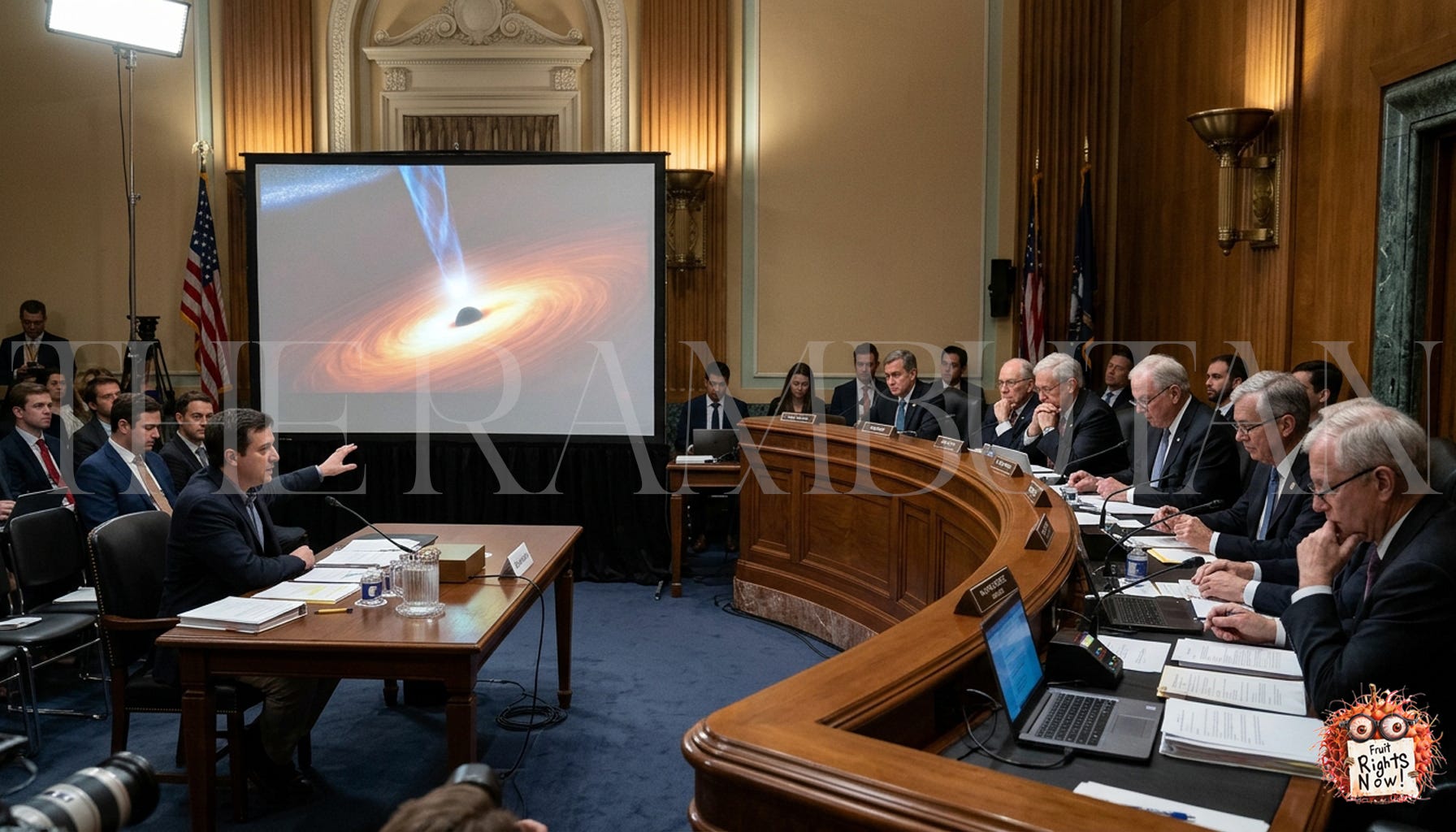
WASHINGTON — Deep-space telescopes have uncovered a supermassive quasar dating back roughly 13.1 billion years, prompting speculation among D.C. political strategists over whether the celestial body is old enough to launch a credible bid for the United States Senate.
The primordial object consists of a supermassive black hole violently consuming matter while spewing immense jets of radiation across the void of space.
According to political consultants, this makes it a frighteningly natural fit for the upper chamber.
“When we first processed the redshift data from the Euclid telescope, our reaction was scientific awe,” explained Dr. Julian Vance, senior astrophysicist at the European Space Agency. “Here was an immobile relic formed during the earliest cooling of the universe, devoid of new ideas, slowly devouring everything within its gravitational pull, and generating cosmic noise without accomplishing anything measurable. Naturally, within twenty minutes, both the Democratic and Republican Senatorial Campaign Committees had reached out to its press team.”
While the United States Constitution requires members of the Senate to be at least thirty years old, modern precedent has established that thirty is just the age at which a politician should begin the first of five consecutive decades in local zoning boards before qualifying for real legislative power.
Insiders note that at 13.1 billion years of age, the quasar might face skepticism from party elders who worry it lacks the decrepitude necessary to navigate the Senate Judiciary Committee.
“Look, there’s always going to be some pushback against these young, flashy candidates who formed right after the Reionization Epoch,” admitted veteran D.C. operative Bradley Vance. “Some of our traditional donors are asking: Can an accretion disk that has only existed since the dawn of time truly understand the nuanced complexity of farm subsidies? Does it remember the Eisenhower administration? Has it ever fallen asleep mid-sentence during a classified defense briefing? But we think voters are hungry for this kind of fresh, youthful energy.”

Within hours of the study’s publication in the Astrophysical Journal, three Super PACs had already filed registration paperwork with the Federal Election Commission.
Staffers on Capitol Hill were quick to evaluate the logistics of seating an object three billion times more massive than the Sun.
“Accommodating the quasar on the Senate floor would be easy compared to wheeling in some of our current members,” noted one anonymous junior staffer. “It doesn’t wander off during roll call votes. It doesn’t require two aides to hold its elbows while it steps over a television cable. And when the Majority Whip walks by and asks for an ‘Aye’ on a procedural motion, the quasar emits a high-frequency gamma-ray burst. That counts as voting in the affirmative under Rule XXII.”
Questions regarding the candidate’s ability to survive a 90-minute televised debate have already been brushed aside. Political analysts pointed out that standing perfectly frozen behind a podium while staring into the abyss is no longer considered a medical emergency during political debates, but rather a sign of statesmanlike composure.
“If the quasar locks up mid-answer and remains silent for three hundred million years,” explained debate coach Sarah Henderson, “we can easily frame that as a moment of reflection on the national debt.”

Perhaps the most compelling argument for the quasar’s candidacy is the Senate’s strictly enforced seniority system. Under traditional chamber rules, an entity that predates the formation of the Milky Way would leapfrog every current committee chairman, instantly securing the gavel for Senate Appropriations.
“Under Senate rules, seniority is god,” said constitutional scholar Marvin Croft. “Strom Thurmond held onto power by continuing to occupy space well past the point of cellular breakdown. An entity that predates the fusion of carbon in stellar cores would hold unchallengeable control over federal highway discretionary funds until the heat death of the universe. It’s an incumbent’s dream.”
Party leaders from both sides of the aisle have praised the quasar’s bipartisan appeal, noting that because it has not uttered a single coherent syllable in thirteen billion years, it has yet to alienate swing voters or take a controversial stance on school lunch programs.
At press time, the quasar’s exploratory committee announced it had already raised $42 million from defense contractors, with campaign managers assuring donors that their candidate remains fully committed to holding office until at least the end of its current thermodynamic cycle.
We write the headlines that haven’t happened yet but probably will. Subscribe to The Rambutan for Southeast Asia’s sharpest fake news.