


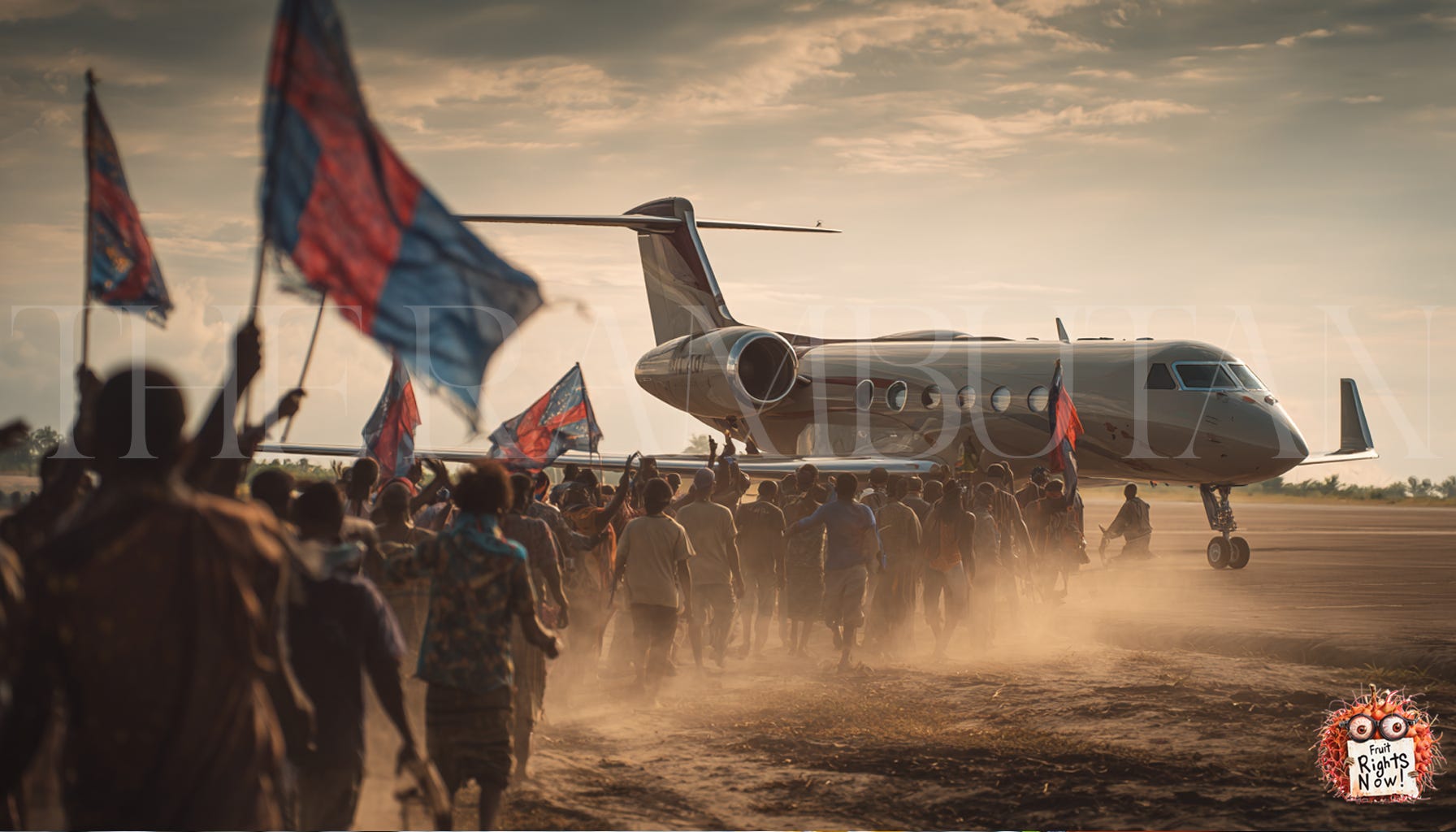
GRATITANIA — Thousands of citizens across the Republic of Gratitania gathered this week to celebrate what government spokespeople are calling “a monumental achievement for the national brand…” the acquisition of a $75 million private jet by businessman and cousin-of-a-minister, Tunji Womalo.
The jet, an ultra-customized Gulfstream G700 outfitted with Italian marble flooring and a rare tropical hardwood conference room, was unveiled on the presidential runway amid cheers, fireworks, and three days of rolling blackouts.
“This is a proud moment,” said Finance Ministry intern Dami Mbeki, holding up a commemorative t-shirt printed with the phrase “Upward Together”. “When Mr. Womalo gets new toys, it means we’re heading in the right direction. If he’s prospering, it must mean trickle-down is only slightly delayed.”
Citizens, many of whom earn under $2 per day, expressed cautious optimism that the new jet would eventually create jobs, or at least distract attention from last week’s announcement that the government could no longer afford to fund public hospitals after July.
Local economist Samson Ukoha explained the significance: “It’s the classic development metric. You get the billionaire, then you get the growth. In Gratitania, we just do it backwards.”
The Central Planning Bureau has confirmed that the jet purchase is now being counted as a foreign direct investment (FDI), since the bank loan was technically processed in Luxembourg and the aircraft was registered through a shell company in Malta.
“We’re updating our economic dashboard,” said Director of National Metrics, Doreen Malu. “From now on, the number of new superyachts, Rolexes, and children enrolled in Swiss boarding schools will be used to track quarterly growth. It’s more accurate than household income data, which tends to depress investor sentiment.”
She added that the country’s per capita GDP may also see a “sharp but statistically misleading increase,” as Mr. Womalo’s asset base is now being averaged across the population.
Meanwhile, a new “Jet for Jobs” initiative was launched, encouraging schoolchildren to write letters of thanks to Mr. Womalo, several of which were posted on social media. One, from a 12-year-old in Beda Province, read: “I hope one day you can fly your plane to our village so we know what clouds look like from above.”

Not everyone was thrilled by the announcement. Some critics raised concerns over the source of the billionaire’s wealth, citing his company’s history of winning no-bid government contracts for “strategic rubber glove stockpiling,” and the mysterious disappearance of a $500 million flood resilience budget last seen routed through his logistics firm, Womalo Global.
When pressed on the optics, Minister Edwin Kalu, clarified that the purchase was “a private matter” and urged citizens to remain focused on national unity.
“The optics are good,” he said. “The chrome finish reflects sunlight, which is a metaphor for hope.”
In the capital, celebratory drone footage captured Mr. Womalo’s jet taking off, escorted by six military helicopters. On the tarmac, school children waved flags and chanted, “If he can fly, so can we… eventually.”
Meanwhile, in nearby Agbada district, street vendor Mama Ifeoma offered boiled cassava to passersby, standing over a pot filled with filtered rainwater.
“We are happy for him,” she said, eyes fixed on the sky. “He is a son of the soil. And maybe one day, he will fly that plane over our village again. Maybe he will wave.”
She smiled. “Maybe that will be our turn.”
We write the headlines that haven’t happened yet, but probably will. Subscribe to The Rambutan for Southeast Asia’s sharpest fake news.