


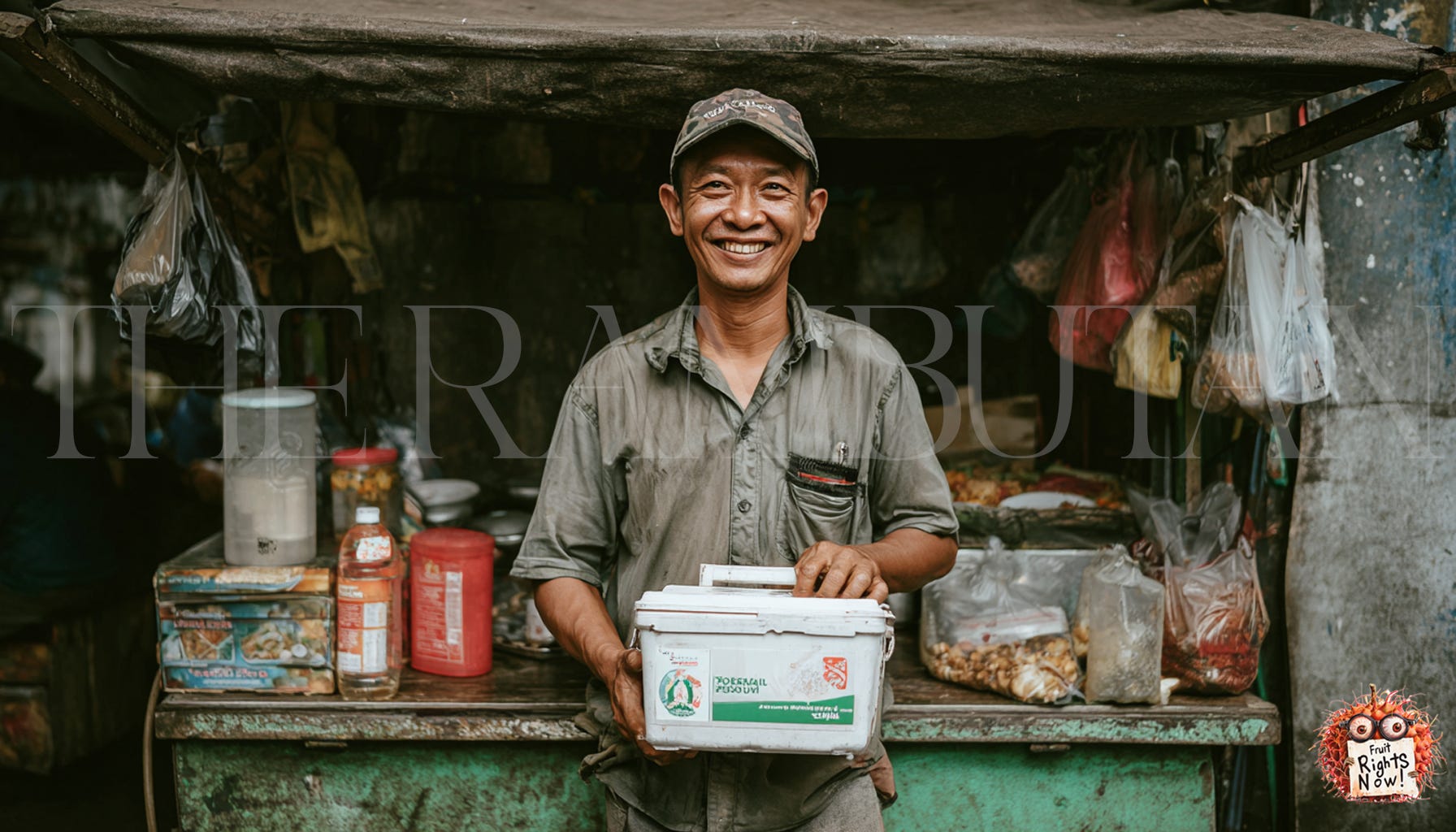
JAKARTA — Local resident Agus Santoso, 36, says he’s never felt more secure, more heard, or more ready to face the future, despite having just Rp600,000 in his bank account and an active payday loan pending approval.
“I may not have much, but the President has a 90.9% trust rating,” Agus said, smiling gently while adjusting his faded #PrabowoMaju2024 hat. “That has to count for something.”
Agus, who works as a freelance signage painter and occasional queue placeholder, attributes his upbeat mood to a mix of government messaging, survey results, and the Free Nutritious Meals (MBG) program his nephew’s school recently launched.
“Ever since I saw the government’s Quality of Life Index hit 65 out of 100, I knew we were on the right track,” he said, cradling a Pemerintah Peduli lunch box half-filled with rice and boiled greens.
At press time, Agus was seen reloading his phone with a borrowed Rp5,000 credit to re-share an infographic titled “Rakyat Bahagia, Negara Kuat” to his WhatsApp group, Keluarga Besar RW 13.
The recent Indonesian Social Survey revealed what analysts are calling “the most uplifting financial contradiction in recent history.” While over 59% of respondents admitted they had to borrow money to get by, and 62.2% of household heads confirmed the same, satisfaction with the government stood at 78% and trust in the President at a near-universal 90.9%.
Agus, who has borrowed money from a neighbor and two fintech apps, says it’s all about mindset.
“Maybe my wallet’s empty,” he said, patting it for emphasis, “but my heart is full. I trust that things are going to be fine. The survey says so.”
He described himself as a member of a growing group of Indonesians who, though financially precarious, remain emotionally invested in the nation’s future. The group, tentatively called “Gaji Tipis, Hati Lega” (Low Pay, Light Heart), has begun hosting biweekly syukuran gatherings to celebrate public sentiment regardless of personal outcomes.
Economists have dubbed the phenomenon “Perceptional Surplus Disorder”, in which national narratives of progress temporarily overshadow indicators of material hardship.

Agus’s sense of national well-being, he says, is grounded in tangible items. Not food security or long-term employment, but the small things, like a government lunch box, a ticket for a now-cancelled bus subsidy, and a laminated thank-you note his nephew received for “successfully eating vegetables.”
“These aren’t just items,” Agus explained. “They’re symbols of care.”
Agus also praised recent political messaging for “keeping spirits high.” Though he could not recall whether MBG applied to adults or not, he says just hearing the term made him feel included in the nation’s plans.
Asked if he had any personal financial goals for the year, Agus nodded. “Yes. I’d like to stay above zero.”
Still, he holds no resentment toward government institutions or economic conditions. “The parties may be unpopular,” he admitted, “but the President? He’s doing his best. And the surveys prove it.”
When asked about the bus ticket he had mentioned earlier, Agus unfolded it carefully. It was from 2018.
We write the headlines that haven’t happened yet, but probably will. Subscribe to The Rambutan for Southeast Asia’s sharpest fake news.