


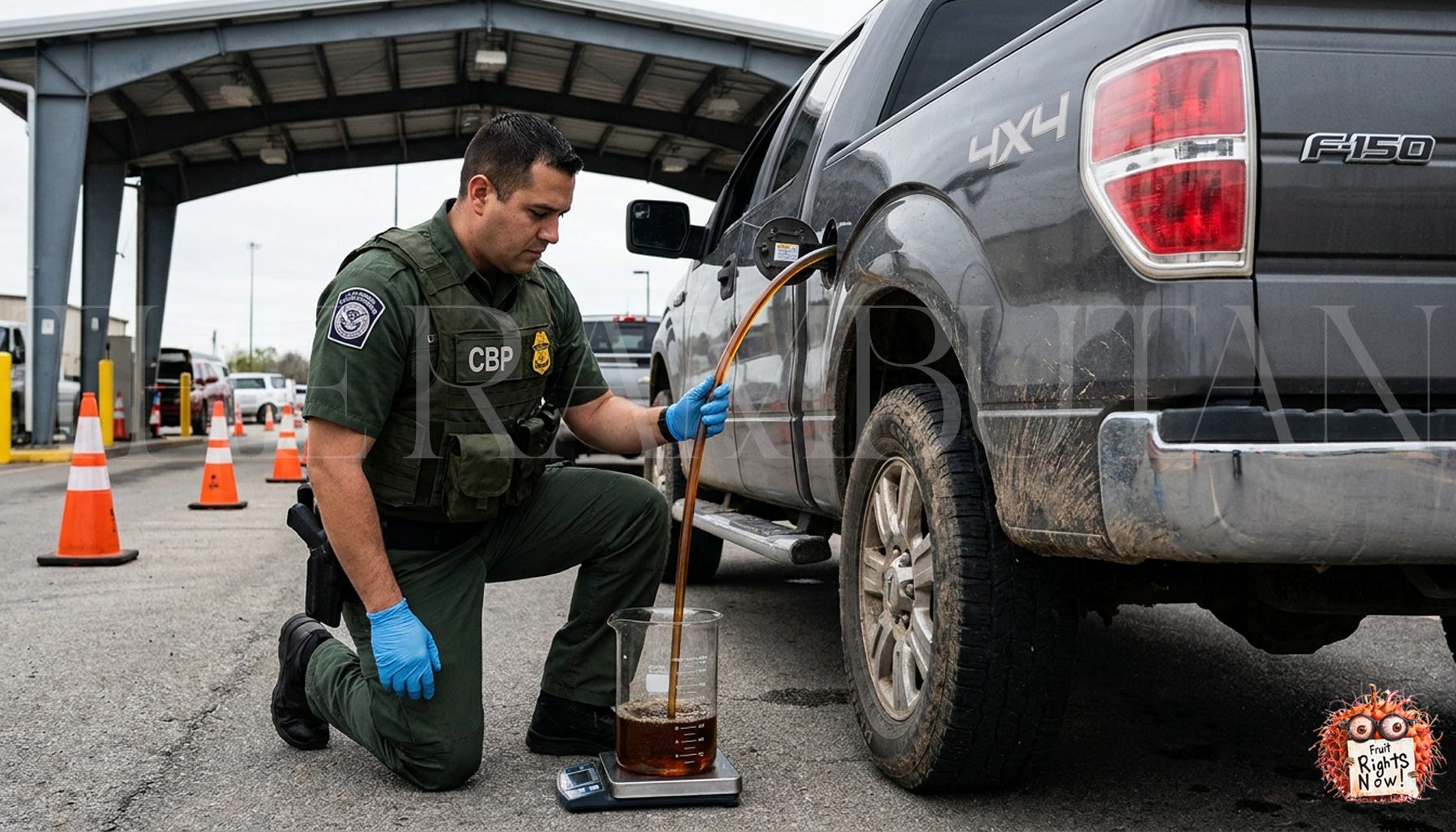
DETROIT, MI — U.S. Customs and Border Protection (CBP) officers stationed at the Ambassador Bridge seized over 50,000 gallons of uncut, contraband Canadian maple syrup concealed inside the modified fuel tanks of a convoy of Ford F-150 pickup trucks.
The raid, executed late Thursday evening, brought a halt to a sophisticated cross-border smuggling operation that authorities say had been fueling an underground pancake economy across the Rust Belt.
According to federal charging documents, border patrol agents grew suspicious when a Michigan-plated 2024 Ford F-150 SuperDuty pulled into primary inspection emitting the heavy aroma of warm French toast rather than diesel exhaust. When canine unit officer “Buster” alerted to the vehicle’s undercarriage, agents drilled into the truck’s auxiliary 36-gallon fuel tank. Instead of petroleum, officers were met with a pressurized stream of 100% pure, single-origin Grade-A Dark Robust syrup.
The seizure marks an escalation in the ongoing cross-border trade skirmish that erupted following late-summer retaliatory tariffs between Washington and Ottawa. With import duties on Canadian agricultural goods soaring past 250%, the domestic price of authentic Canadian syrup skyrocketed, leaving millions of middle-class American breakfast enthusiasts cut off from their morning fix.
“What we are seeing on the northern border today is unlike anything since the days of Al Capone,” said CBP Port Director Dale Higgins during a Friday morning press briefing. “These aren’t your grandfather’s maple farmers tapping trees in flannel shirts. These are ruthless, highly organized syndicate couriers operating out of Montreal.”
According to investigators, the smuggling ring had weaponized America’s best-selling pickup truck to exploit supply-chain loopholes between Windsor and Detroit. By lining the fuel tanks, windshield wiper fluid reservoirs, and tire wells with food-grade polymer coatings, couriers were able to haul up to 400 gallons of viscous contraband per vehicle across international lines without triggering standard agricultural weight sensors.

On the black market, the rewards far outweigh the risks. Federal agents estimate the seized haul carried a street value exceeding $4.2 million. In suburban cul-de-sacs across Michigan, Ohio, and Indiana, desperate suburban fathers are reportedly paying up to $90 cash behind bowling alleys for an unmarked eight-ounce flask of authentic Canadian tap.
“You can’t go back to high-fructose corn syrup once you’ve tasted pure Quebec tree blood,” said one anonymous suburban dad from Troy, Michigan, who admitted to buying bootleg amber out of the trunk of a Buick LeSabre. “The store-bought domestic stuff is garbage. It’s just brown water and sorbitol. My kids can tell the difference. My wife looks at me differently when the waffles are dry. I did what I had to do.”
Law enforcement officials warned that the illicit trade poses severe health and safety risks, not only because of cartel price-gouging, but because of dangerous “cutting agents” being introduced at the street level.
“Street-level dealers are stepping on this product to maximize margins,” warned DEA Special Agent Marcus Vance. “They’re taking pure Grade-A Canadian nectar and cutting it with table molasses, melted butterscotch, and cheap Log Cabin syrup. We’ve had reports of people pouring what they thought was pure sap onto their silver-dollar pancakes, only to realize it was 40% tap water and caramel coloring. It’s sickening.”
The Department of Homeland Security announced it will deploy additional drone surveillance and thermal-imaging aircraft over Lake Huron to track rogue pontoon boats suspected of running midnight syrup drops onto secluded Michigan beaches.
Meanwhile, political fallout from the bust continues to mount on Capitol Hill. While some lawmakers have called for the immediate nationalization of Vermont’s strategic maple reserves to stabilize market panic, White House economic advisors assured the public that domestic production of “Freedom Syrup” will hit grocery shelves before the midterms.
We write the headlines that haven’t happened yet, but probably will. Subscribe to The Rambutan for Southeast Asia’s sharpest fake news.