


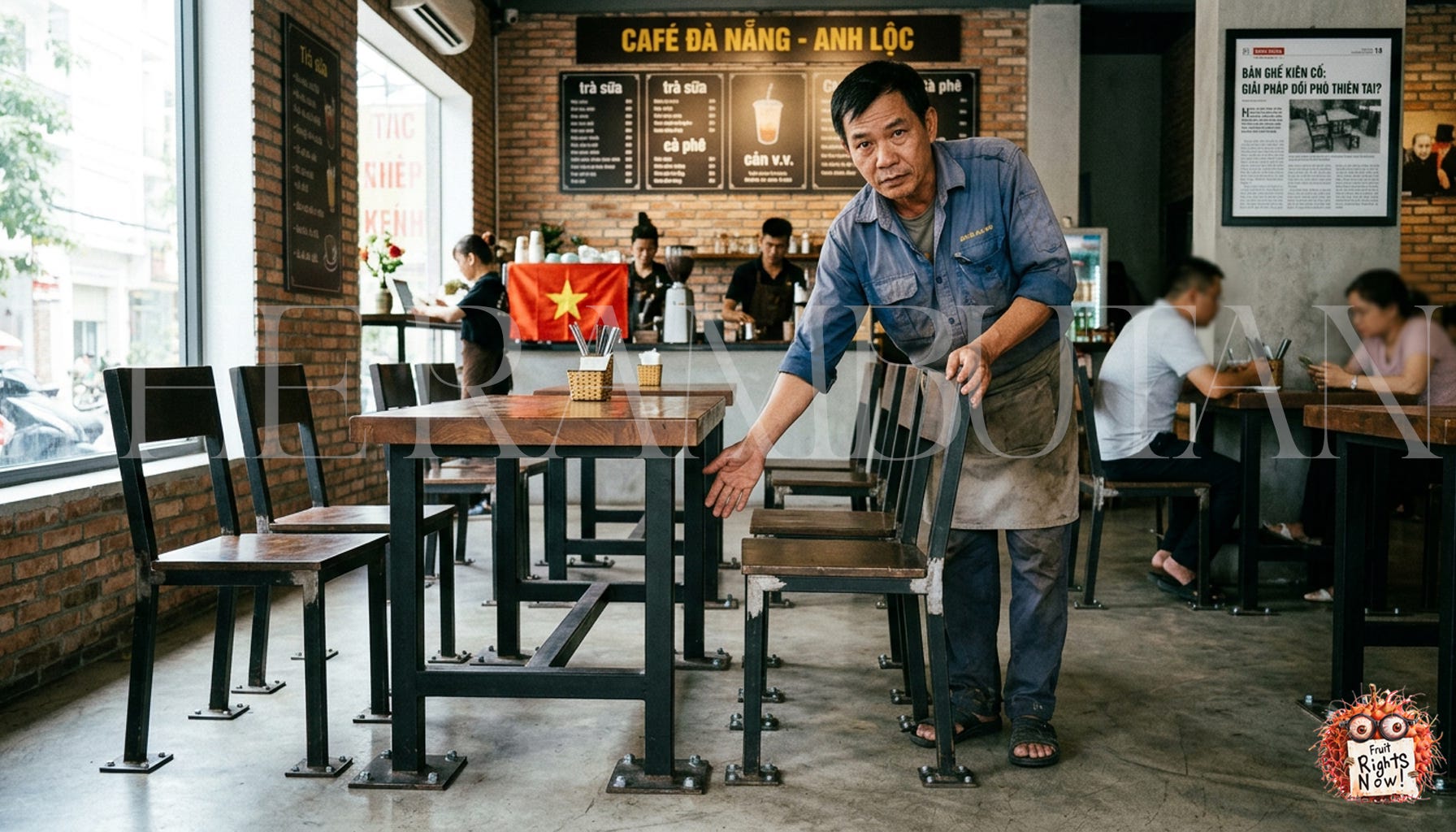
DA NANG — Following a recent incident in which an Australian tourist allegedly mistook a local café for a rage room, one Da Nang coffee shop has announced a new safety initiative.
The café, located in one of Da Nang’s busiest tourist districts, unveiled the new security upgrade Tuesday morning during a ribbon-cutting ceremony attended by staff, local residents, and one man from Melbourne who insisted he was “just looking for a flat white.”
According to the café’s owner, the decision was made after management concluded that ordinary furniture was no longer sufficient in the modern tourism economy.
“We realized we had been naïve,” said café owner Nguyễn Thị Hạnh. “For years, we believed furniture was something customers sat on. We now understand furniture is something certain foreign visitors may attempt to fight.”
The café’s new “Australian-Proof Hospitality System,” or APHS, includes reinforced tables, immovable chairs, and a new laminated menu printed on the same material used for aircraft black boxes.
The new installation was completed by a team of engineers who normally work on structures expected to withstand earthquakes.
Lead engineer Trần Minh Quang said the project presented unique challenges because traditional civil engineering calculations rarely account for “one shirtless man from Brisbane operating at full holiday velocity.”
According to Quang, the team began by reviewing footage of previous bar incidents, and Australians explaining that “this is actually normal where I’m from.” Engineers then developed a new scale of measurement known as the International Boganic Impact Rating.
“Your average chair can withstand a tired office worker, a teenager scrolling TikTok, or an uncle arguing about football,” Quang said. “But once you introduce a sunburned tourist who has consumed five beers, and misunderstood the bill, everything changes.”

In addition to its reinforced interior, the café has introduced a revised menu and customer intake process.
Guests are asked a series of simple screening questions, including: “Have you recently lost a passport?”, and “Are you currently wearing a shirt?”
Customers who pass the screening may proceed to the counter, where they can order traditional Vietnamese coffee.
Local residents have responded positively to the changes, with many praising the café’s practical approach to a growing challenge in Vietnam’s tourist-heavy cities.
“I think it is good,” said one Da Nang resident. “Tourists are welcome here. But sometimes they arrive with the energy of a man fighting an invisible crocodile. It is better to prepare.”
Local tourism officials reportedly praised the café’s renovation as an important step toward maintaining Da Nang’s reputation as a welcoming, scenic destination.
“Da Nang is proud to host visitors from around the world,” said a representative from the city’s Department of Tourism. “We want every guest to enjoy our beaches, food, culture, and cafés.”
The department is now said to be studying whether similar “tourist-resistant” upgrades should be rolled out to other businesses, including beach bars, and hostels.
Some businesses have already expressed interest. A nearby hotel is reportedly testing “British-proof balcony railings,” while a motorbike rental shop has introduced an “American-proof helmet.”
Despite the upgrades, Hạnh said she remains optimistic about foreign tourism and believes the incident has ultimately made the café stronger.
“Vietnamese people are resilient,” she said. “Our businesses survived lockdowns, app delivery fees, and customers who sit for six hours after ordering one iced tea. We can survive one angry Australian.”
We write the headlines that haven’t happened yet, but probably will. Subscribe to The Rambutan for Southeast Asia’s sharpest fake news.