


MANILA — A panel of leading economists announced Thursday that the Philippine ₱1,000 bill is no longer classified as legal tender in the traditional sense, but is now “functionally closer to a coupon.”
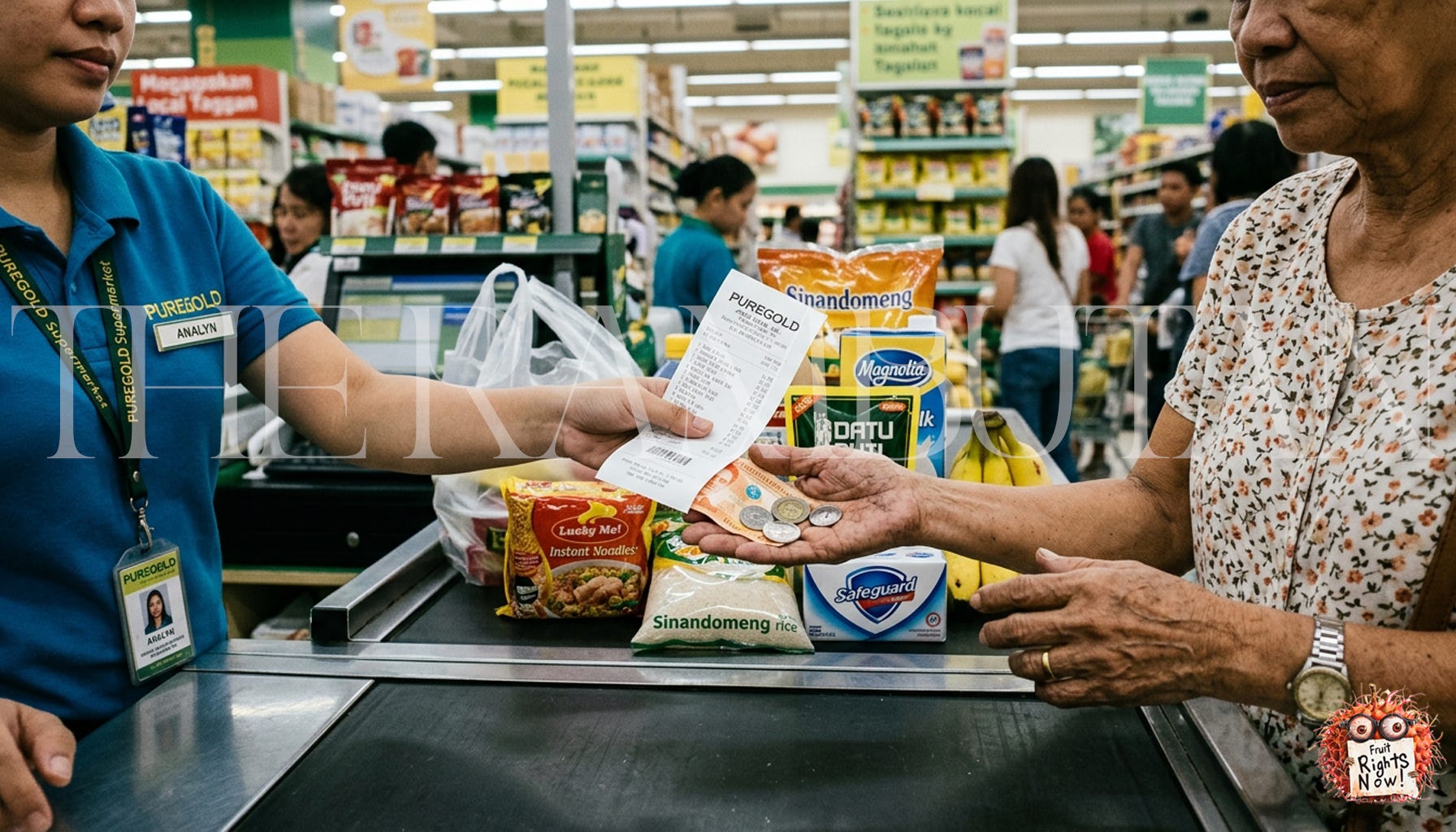
The announcement came after months of careful observation, during which researchers noticed that a ₱1,000 bill, once capable of purchasing several useful goods, now mostly serves as a decorative paper token exchanged for one plastic bag of groceries.
“This is not inflation in the alarming sense,” said Dr. Renaldo Ignacio. “What we are seeing is an evolution of money. The ₱1,000 bill has not lost value. It has simply become more selective about what it can buy.”
Officials welcomed the findings, noting that inflation has recently “moderated,” a term defined as “prices continuing to go up, but in a way that allows press conferences to sound better.”
At a briefing in Quezon City, spokesperson Marites Villanueva praised the country’s resilience and urged Filipinos to focus on the positive side of shrinking purchasing power.
“Filipino families are incredibly adaptive,” Villanueva said. “Where previous generations needed three meals a day, today’s households are embracing a more streamlined, minimalist approach to nutrition. This is innovation.”
She added that many citizens had already adjusted by replacing expensive food items with more affordable alternatives, such as replacing beef with chicken, chicken with eggs, and eggs with instant noodles.”
When asked whether the government had any concrete plans to address rising costs, Villanueva confirmed that several agencies were “closely monitoring the situation,” which officials described as the most powerful known form of intervention.

Several supermarkets across Metro Manila have already begun adapting to the ₱1,000 bill’s new coupon-like status.
At a grocery store in Makati, manager Lito Santos said customers frequently enter with confidence, pick up basic household items, calculate the total, return three of them, and then stand motionless in the canned goods aisle.
Several shoppers welcomed the change.
“I used to think ₱1,000 was a lot of money,” said 34-year-old office worker Carla Mendoza.
Another shopper, tricycle driver Boyet Ramos, said he had begun treating large bills with religious reverence.
“When I get a ₱1,000 bill, I don’t spend it right away,” Ramos said. “I hold it, look at it, then remember the good times.”
Banks have also responded to the shift. Several financial institutions are reportedly testing new ATM messages to prepare customers before dispensing cash.
Financial advisers are urging Filipinos to remain calm and practical.
“During uncertain times, it is important to budget wisely,” said personal finance coach Abigail Torres.
Torres recommends households follow the popular 50/30/20 rule, updated for current conditions as the 90/10/0 rule: 90 percent for necessities, 10 percent for surprise price increases, and 0 percent for wants.
“For entertainment, families can gather around the dining table and guess what things used to cost,” she said. “It’s free, and educational.”
Economists also advised workers to diversify their income by having a day job, a night job, a weekend job, and a small online business.
“Multiple income streams are essential,” Dr. Ignacio said. “Ideally, every Filipino should have at least three: employment, side hustle, and a relative abroad.”
At press time, the Bangko Sentral ng Pilipinas was reportedly considering a redesign of the ₱1,000 bill to include fine print reading: “Valid for one transaction only. Purchasing power may vary.”
We write the headlines that haven’t happened yet, but probably will. Subscribe to The Rambutan for Southeast Asia’s sharpest fake news.