


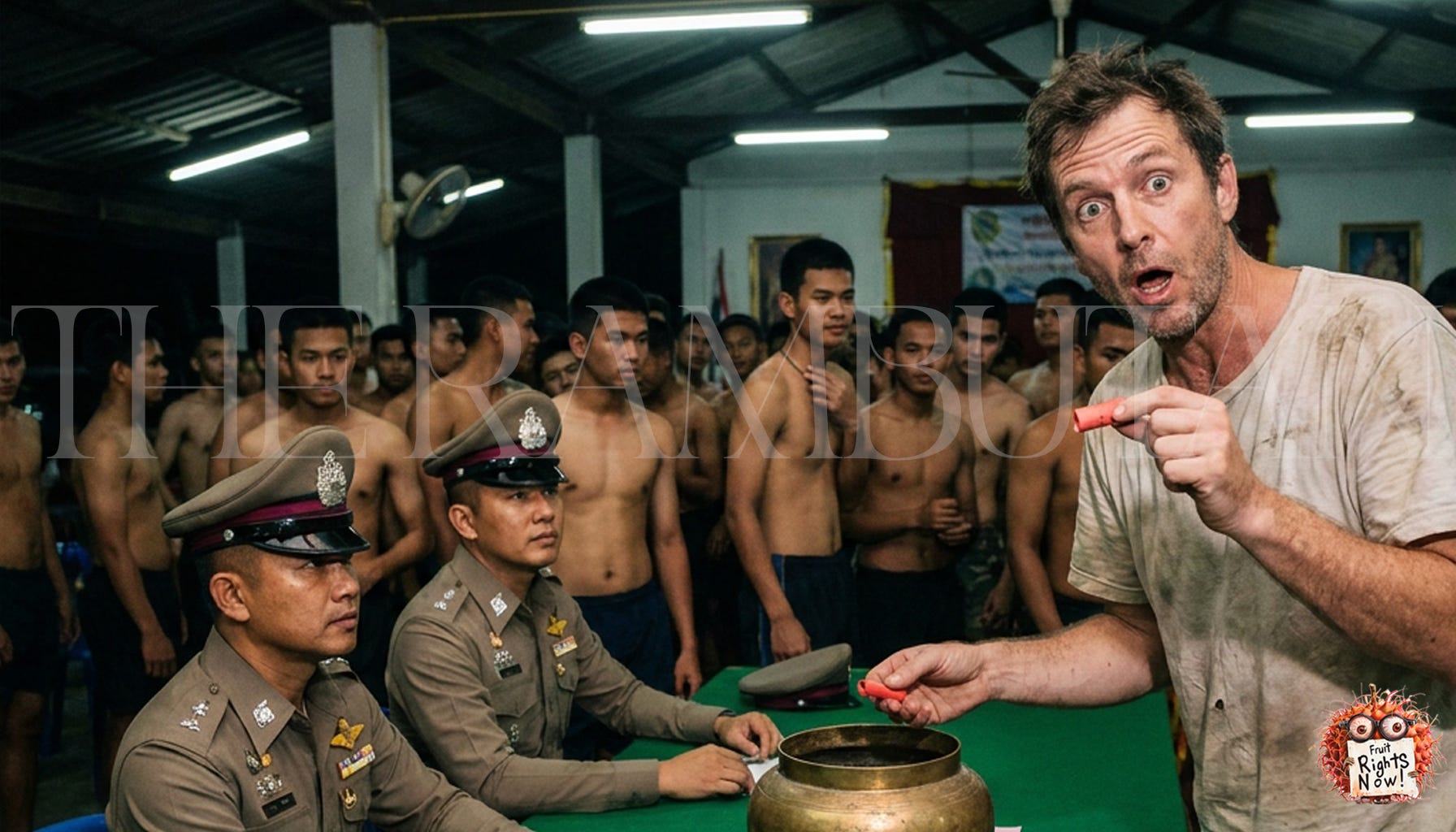
CHIANG MAI — Local digital nomad Bradley Miller, 29, believed he had finally cracked the ultimate Southeast Asian cheat code on Tuesday afternoon when he purchased a fraudulent Thai National Identification Card for 15,000 baht behind a craft kombucha bar in Nimman.
His objective was simple: he was unwilling to pay the 300-baht “foreigner price” to look at a waterfall in Doi Inthanon National Park when local citizens were only paying 20 baht.
Forty-eight hours later, Private Miller was standing at attention in standard-issue jungle fatigues on the gravel parade grounds of the 33rd Military Circle, having successfully drawn a red card in the Royal Thai Armed Forces annual conscription lottery.
Miller, who originally hailed from suburban Ohio before discovering his spiritual home in co-working spaces across northern Thailand, explained that the forged identification was meant purely as a defensive financial maneuver against the scourge of dual pricing.
“The economics were undeniable,” Miller stated. “I calculated my projected waterfall visits over the next seven fiscal quarters. Factoring in temple admission, museum entrance fees, and the occasional national park surcharge, the forged ID card had an estimated return on investment of roughly fourteen months.”
The fake identification document, acquired from a recently dismantled Chiang Mai civil registry forgery ring, designated Miller as “Mr. Somchai Throgmorton-Phaiboon,” born in Mae Rim district and currently classified as an able-bodied, single male of prime draft eligibility.
According to witnesses, Miller’s first official use of the forged credential at a local municipality checkpoint went flawlessly. The inspecting officer scanned the card, smiled warmly, nodded at the Thai microchip, and handed Miller a laminated draft registration notice.
“I assumed it was a VIP loyalty voucher for discounted mango sticky rice,” Miller remarked. “It turned out to be an immediate summons to the district sports complex.”

On Thursday morning, Miller arrived at the Mae Rim district auditorium dressed in linen shorts, Birkenstocks, and a sleeveless linen shirt, expecting a routine verification process. Instead, he found himself seated in the front row of plastic chairs surrounded by three hundred shirtless nineteen-year-olds and two Buddhist monks.
The Thai military conscription lottery functions on a binary probability model: young men draw a rolled ticket from an opaque metal urn. A black slip grants immediate civilian exemption; a red slip grants a non-negotiable two-year enlistment into the Royal Thai Army.
“The foreign gentleman walked up to the stage, bowed deeply to the presiding colonel, and enthusiastically reached into the bucket,” said Warrant Officer Somkid Ratanaporn. “When he unrolled the red card, the entire auditorium erupted into wild celebration. His mother wasn’t there, but three aunties from the local wet market threw marigold garlands around his neck and began sobbing with national pride.”

By Friday morning, Miller’s signature unkempt man-bun had been shaved down to a military-grade buzzcut. His daily routine of drinking iced oat milk matcha lattes while arguing about Bitcoin, had been replaced by 5:00 a.m. calisthenics, perimeter trench digging, and heavy logistics drills in 95-degree tropical humidity.
When reached for comment Miller maintained a relentlessly positive outlook on his macroeconomic portfolio.
“Look, is basic infantry training physically grueling? Absolutely. Are the 4:30 a.m. bugle calls disrupting my circadian rhythm? Without question,” Miller wheezed. “But let’s not lose sight of the big picture here: yesterday our battalion marched straight through the gates of Ob Khan National Park during tactical navigation maneuvers.”
At press time, Miller was seen attempting to barter a portion of his military-ration sticky rice to convince his drill sergeant that attending next week’s jungle survival simulation should count as an official co-working business expense for tax purposes.
We write the headlines that haven’t happened yet, but probably will. Subscribe to The Rambutan for Southeast Asia’s sharpest fake news.