


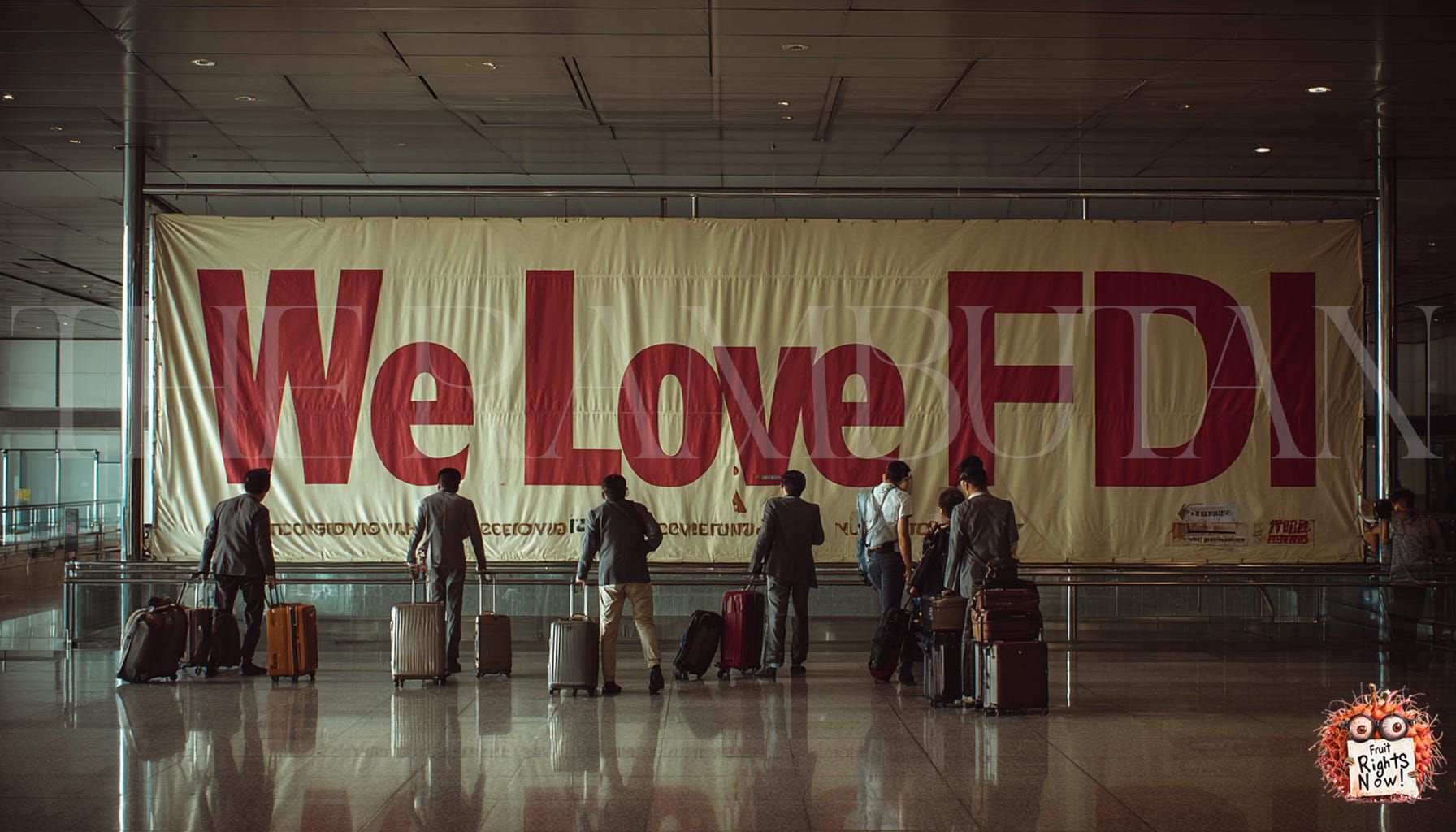
JAKARTA — A foreign investor arriving at Soekarno-Hatta International Airport on Tuesday was momentarily uplifted by a billboard-sized banner reading “Welcome to Indonesia: We Love FDI!” only to discover, minutes later, that the sign had no practical function whatsoever.
“It was a beautiful moment,” said Richard H. Kingsley, Managing Director at Global Frontier Capital, clutching a thick binder of project proposals. “I thought to myself, Finally. A country that values our capital.”
Unfortunately, Kingsley’s optimism was quickly replaced by a five-hour visa processing delay, followed by three missed meetings, and a politely-worded email informing him that his proposal was under review by an inter-ministerial working group. When asked when to expect feedback, he was told, “We’re still finalizing the framework for finalizing the framework.”
The investor’s welcome pack included a stapled government brochure titled Investing in Indonesia: It’s Happening, and a single QR code that redirected to a login page requiring an Indonesian tax ID.
According to multiple sources, the “We Love FDI” signage was part of a long-running campaign to project openness, now entering its twelfth year. When pressed on whether the slogan translates into actual access, one official clarified, “It depends. We are very open to investment. Just not in strategic sectors. Or non-strategic sectors. Or anything involving retail distribution, food, digital platforms, nickel, data, logistics, or electricity.”
Investors seeking permits for those sectors are encouraged to apply through Danantara, a sovereign wealth fund that holds the nation’s strategic assets.
Applicants who make it through the front-end submission process may be invited to submit the same documents again, this time via email, then again by fax, then physically to an office whose coordinates are still not appearing on Google Maps.
Officials insist this is not meant to discourage investment, only to “ensure proper alignment with national priorities.” When asked to list those priorities, an assistant shuffled papers and said, “That is still being socialized.”

Kingsley eventually managed to secure a meeting with a deputy assistant director of regional affairs, who asked if he had considered simply investing through one of Indonesia’s trusted state-owned enterprises. “We encourage partnership,” the official said, smiling and handing him a brochure from 2017.
When Kingsley asked about currency transfer flexibility, the official reassured him that all dollars would be lovingly retained onshore for twelve months, where they could bask in the warmth of Indonesia’s financial system before being released, conditionally, after proper inspection and under close supervision.
Asked if he would continue with the process, Kingsley hesitated. “We’ve invested in war zones before, but at least there, people pick up the phone,” he said. “Here, I can’t tell if the door is locked or just politely refusing to open.”
At press time, Kingsley was seen outside the Danantara office, waiting for someone to accept his visitor badge. Security informed him he was not on the list, but could try again next quarter.
We write the headlines that haven’t happened yet, but probably will. Subscribe to The Rambutan for Southeast Asia’s sharpest fake news.