


JAKARTA — Officials have praised Indonesia’s Free Nutritious Meals program for providing millions of schoolchildren with valuable real-world training in forensic observation and microbial risk assessment.
According to administrators, students participating in the program have demonstrated rapid progress in skills once reserved for laboratory technicians and health inspectors.
“Before MBG, many children would simply eat whatever adults placed in front of them,” said Dr. Budi Santosa. “Today, these students know to examine the rice for unusual moisture and test the chicken’s structural integrity.”
Officials described the development as a major success for Indonesia’s education system, which has long struggled to equip young people with practical skills for the modern economy.
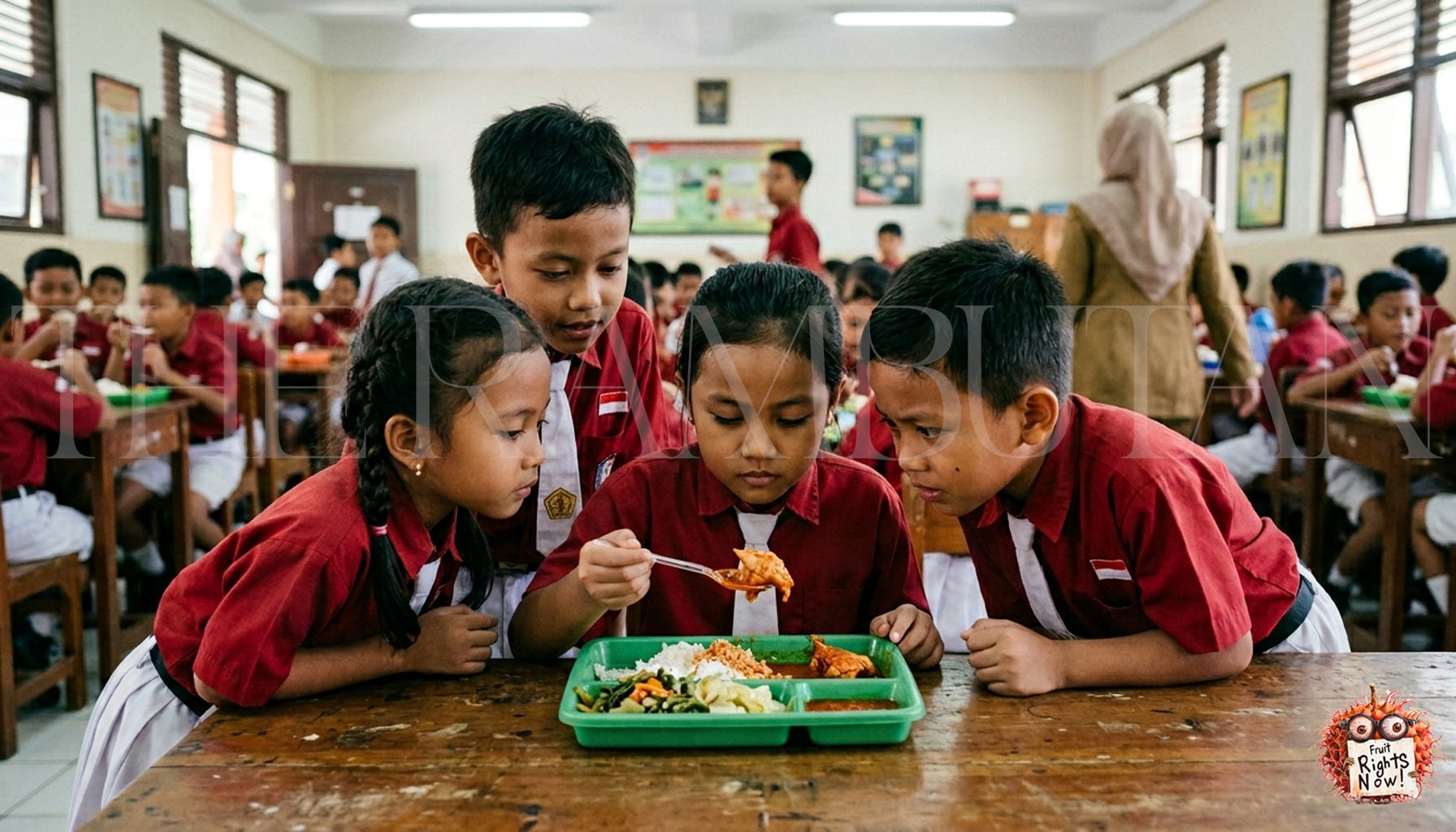
At one elementary school in Jakarta, pupils were observed conducting a sophisticated pre-lunch inspection before allowing anyone to eat.
Under informal procedures developed entirely by the students, each meal must pass a seven-stage assessment before consumption. The assessment includes visual inspection, smell analysis, texture verification, peer review, consultation with the class’s bravest child, a brief prayer, and waiting to see whether anyone at the next table collapses.
Officials say this “distributed testing model” is both cost-effective and educational.
“It would be prohibitively expensive to inspect every meal using trained professionals,” explained a program representative. “Fortunately, children are naturally curious, highly observant, and available.”

“What some people are calling a food-safety incident, we are calling a surprise practical examination,” said spokesperson Ratna Purnamasari. “You cannot teach emergency preparedness exclusively through textbooks.”
Purnamasari emphasized that students who experience nausea are learning to recognize symptoms, communicate clearly with adults, and locate the nearest bathroom under pressure.
To support the program’s new educational mission, schools may soon receive official Meal Investigation Kits containing disposable gloves, magnifying glasses, pH strips, evidence bags, and activated charcoal.
Officials advised parents not to ask whether the food was safe, explaining that such binary thinking could undermine the program’s spirit of scientific discovery.
Government planners now believe the program could address several long-term workforce challenges by creating a generation of highly experienced food inspectors.
By the age of twelve, participating students may have examined more mass-produced meals than many municipal health officers encounter during their entire careers.
“This is an unprecedented national talent pipeline,” said Santosa. “Other countries wait until university to teach risk management.”
The Ministry of Education is reportedly considering integrating MBG inspections into the national curriculum.
Under the proposed system:
Mathematics lessons would involve calculating the statistical probability that an entire class developed stomach pain independently.
Biology students would identify microorganisms using only smell and collective intuition.
Civics lessons would teach children which agency is responsible for a meal after every agency has denied responsibility.
At the time of press, officials confirmed that the children who ate the meals had performed significantly worse than those who inspected them.
We write the headlines that haven’t happened yet, but probably will. Subscribe to The Rambutan for Southeast Asia’s sharpest fake news.