


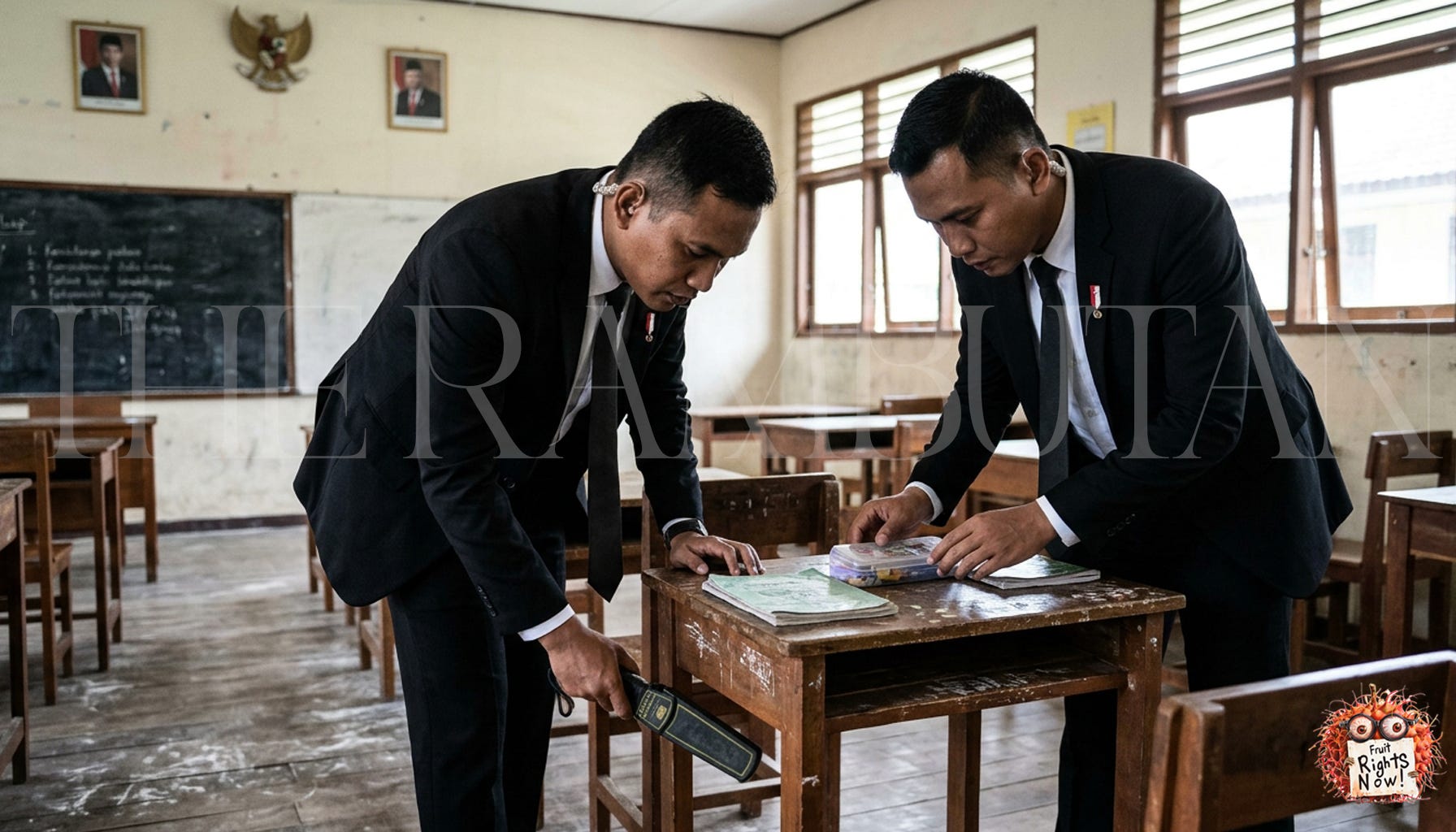
JAKARTA — In an address delivered from the steps of the Vice Presidential Palace on Friday, Vice President Gibran Rakabuming Raka announced his resignation from the nation’s second-highest executive office, citing a deeply personal desire to finally finish the 12th grade.
The announcement ended weeks of constitutional debate, where a coalition of 120 lawmakers in the House of Representatives (DPR) had begun drafting a formal Right to Express an Opinion (Hak Menyatakan Pendapat) motion regarding the provenance of his secondary school diploma.
However, Gibran clarified that the political storm had absolutely nothing to do with his departure. Rather, he explained, the daily burdens of steering Southeast Asia’s largest economy were simply getting in the way of his evening cram sessions for the national equivalency exam (Kejar Paket C).
“Being the Vice President of the Republic of Indonesia has been a tremendous privilege, but deep down, every man has a mountain he has yet to climb,” Gibran told reporters. “For some men, that mountain is constitutional reform. For me, it is quadratic equations, basic cell biology, and finally finding out what happens at the end of the Indonesian history textbook.”
According to palace insiders, the decision had been brewing for months as the young statesman struggled to balance high-level bilateral summits with his mounting pile of photocopied student worksheets. Sources close to the Vice President revealed that while Gibran was capable of chairing Cabinet coordination meetings and receiving foreign ambassadors, his mind was frequently occupied with the Pythagorean theorem.
“People assume that when a politician steps down amid a parliamentary inquiry, it must be because of mounting legal pressure,” said one senior palace communications staffer who spoke on the condition of anonymity. “That is completely unfair. Mas Gibran simply realized that he could not oversee regional autonomy while remaining uncertain about how photosynthesis works. He is doing the honorable thing by going back to the basics.”

Arrangements for Gibran’s academic transition are already underway. Beginning next week, the former vice president will reportedly attend evening classes at a Community Learning Activity Center (PKBM) operated out of a repurposed vocational school.
Classmates at the center, predominantly comprised of ride-hailing drivers, aspiring village chiefs, and teenage vocational dropouts, expressed enthusiasm about studying alongside the former dignitary.
“It’s very inspiring,” said 42-year-old motor-taxi driver and fellow Paket C candidate Hendra Wijaya. “Usually, politicians lie about their credentials for their entire careers. It takes a truly humble leader to quit running the country, sit down on a plastic chair and share an eraser with a guy named Bambang so he can finally learn what a metaphor is.”

Across the political aisle, the establishment offered praise for the former vice president’s sudden departure. President Prabowo Subianto, who was reportedly briefed on the matter during a quiet dinner at his private estate in Hambalang, was said to have fully endorsed his junior partner’s educational sabbatical.
“A soldier never leaves a fallen comrade behind, and a student never leaves a 10th-grade chemistry module uncompleted,” President Prabowo said in a brief statement released by the Cabinet Secretariat. “I have told Gibran that while the executive branch will miss his presence, the nation will be far better served once he understands long division. We wish him swift victories on the academic battlefield.”
When asked by reporters whether he harbored ambitions of returning to national politics once his academic standing is firmly established, Gibran offered a modest smile.
“Right now, I am taking things one semester at a time,” Gibran concluded. “First, I want to conquer the 2027 national examinations. After that, who knows? Perhaps I will run for class president.”
We write the headlines that haven’t happened yet but probably will. Subscribe to The Rambutan for Southeast Asia’s sharpest fake news.
( hey Clarence Thomas fyi!!!)
Republican leaders have HISTORY of despising black Americans and ANY black skinned human beings.
President Ronald Reagan
vetoed the Anti Apartheid Act of 1986 on September 26, 1986.
Reagan's Reasoning: Reagan stated he opposed punishing a country for choosing an all white government /apartheid, Reagan argued that South Africa's Black majority of residents are full of violence, and refuse peaceful change.
Congressional Override: Congress overrode Reagan's veto—313–83 in the House on September 29 and 78–21 in the Senate on October 2, 1986—enacting the law over his objection. Democrats in a majority voted to over rule the veto.
Key Sanctions: The law banned new U.S. loans and investments in South Africa, barred imports of goods like steel, iron, coal, and agricultural products, and revoked South African Airways landing rights
Historians and economists generally agree that the sanctions contributed to ending apartheid, though they debate how decisive the U.S. law was compared to other pressures.
Within five years of the Anti Apartheid Act becoming law in 1986, South African President F.W. de Klerk released Nelson Mandela, unbanned opposition groups, and began dismantling apartheid laws.