


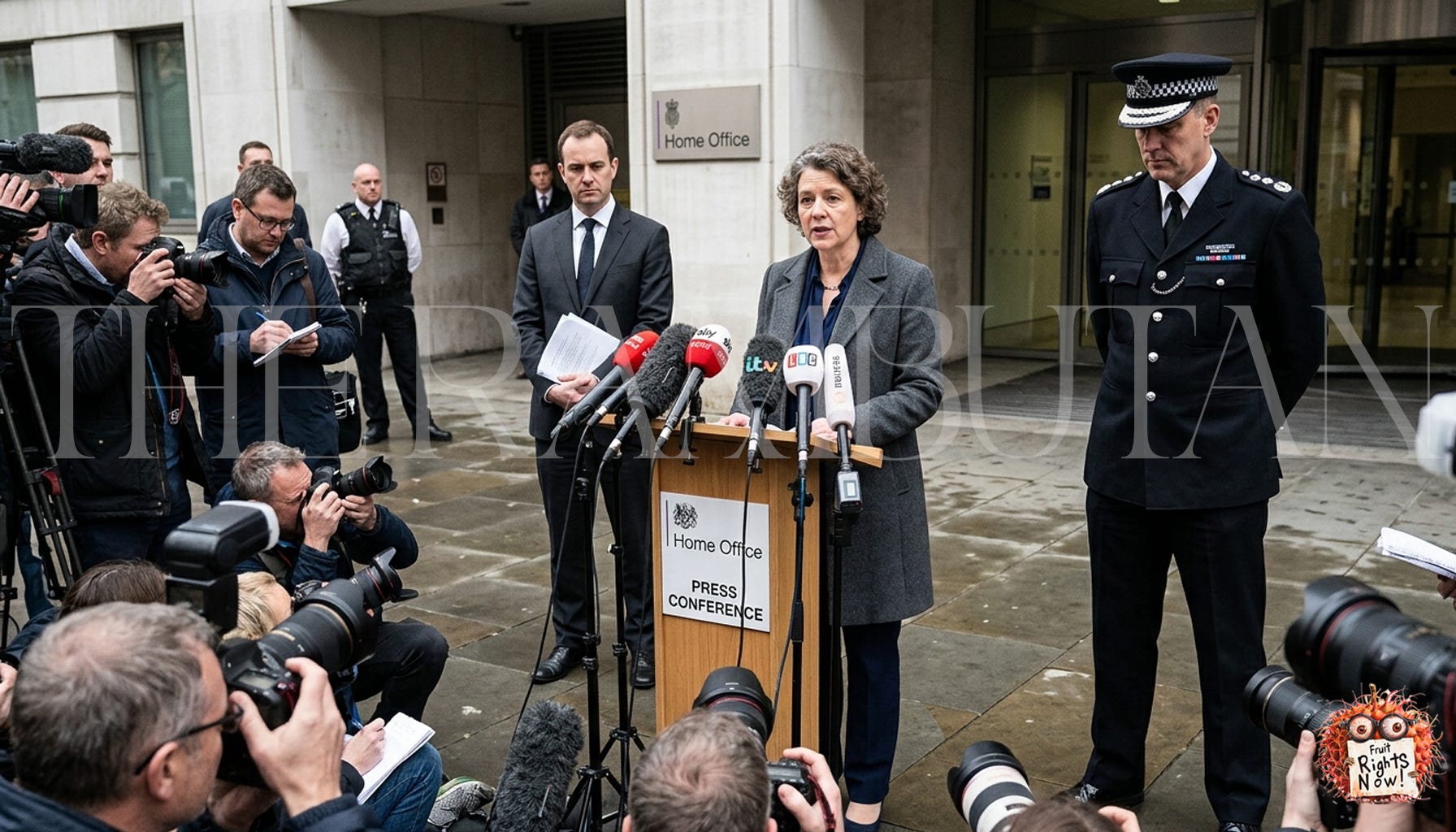
WESTMINSTER — The government has announced a new three-tier policing model designed to end the growing national argument over whether Britain currently has two-tier policing.
Under the new system, citizens will no longer have to worry about whether laws are being applied unevenly, because a freshly created third category will apply specifically to anyone who notices, or questions the first two.
“This government has listened carefully to concerns that some people believe there are two tiers of policing,” said spokesperson Eleanor Whitcombe at a press conference outside the Home Office, flanked by three police liaison officers.
“That is why we are proud to announce a third tier, which will ensure that anyone complaining about two-tier policing is placed into a separate, carefully monitored category of their own.”
According to government briefing documents, the new model will divide the public into three clear and legally robust groups.
Tier One will cover citizens who are “peacefully expressing concern in a manner broadly consistent with the government’s preferred tone.”
Tier Two will cover citizens who are “peacefully expressing concern in a manner that may become concerning if viewed in the wrong context, or liked by the wrong account.”
Tier Three will cover citizens who ask why Tier One and Tier Two appear to be treated differently.
A senior Home Office source explained the policy in simpler terms.
“If someone protests, that’s a policing matter,” the source said. “If someone counter-protests, that’s also a policing matter. But if someone asks why one protest appears to receive a different response from another protest, that becomes a dangerous meta-policing matter, and obviously we need a separate tier for that.”

The government has strongly denied that the new policing tier amounts to a crackdown on criticism, explaining that criticism remains completely legal provided it is expressed privately, and preferably after the matter has left the news cycle.
A new National Confidence And Narrative Stability Unit will be established to monitor public confidence in policing and intervene whenever members of the public appear to be losing it too visibly.
“The purpose of the unit is not to suppress debate,” said Cabinet Office Minister Daniel Frobisher. “It is to ensure that debate occurs in a safe, responsible, and government-approved sequence.”
Asked what that sequence would be, Frobisher said the public should first express concern, then await reassurance, then accept the reassurance, then move on.
Government insiders say the new system is intended to restore faith in British policing by removing the stressful burden of citizens forming their own impressions from things they see happening in front of them.
“I used to think the problem was that police treated people differently depending on the politics of the situation,” said Mark Ellison, 46, a delivery driver from Kent. “But now I understand the real problem is that I noticed.”
Ellison said he was pleased to learn that his concerns would be handled under a dedicated tier.
“It’s nice to feel seen,” he added. “Though apparently that’s also part of the problem.”
Meanwhile, Reform-aligned figures claimed the announcement proved their point entirely. Government ministers denied this, saying the policy could not prove their point because their point had already been referred to the National Confidence And Narrative Stability Unit for contextual review.
By late afternoon, the Home Office confirmed that the launch had been a success, citing the fact that almost everyone was now arguing about the third tier instead of the original two.
At press time, the government was reportedly considering a fourth tier for people who noticed that the third tier seemed suspicious.
We write the headlines that haven’t happened yet, but probably will. Subscribe to The Rambutan for Southeast Asia’s sharpest fake news.