


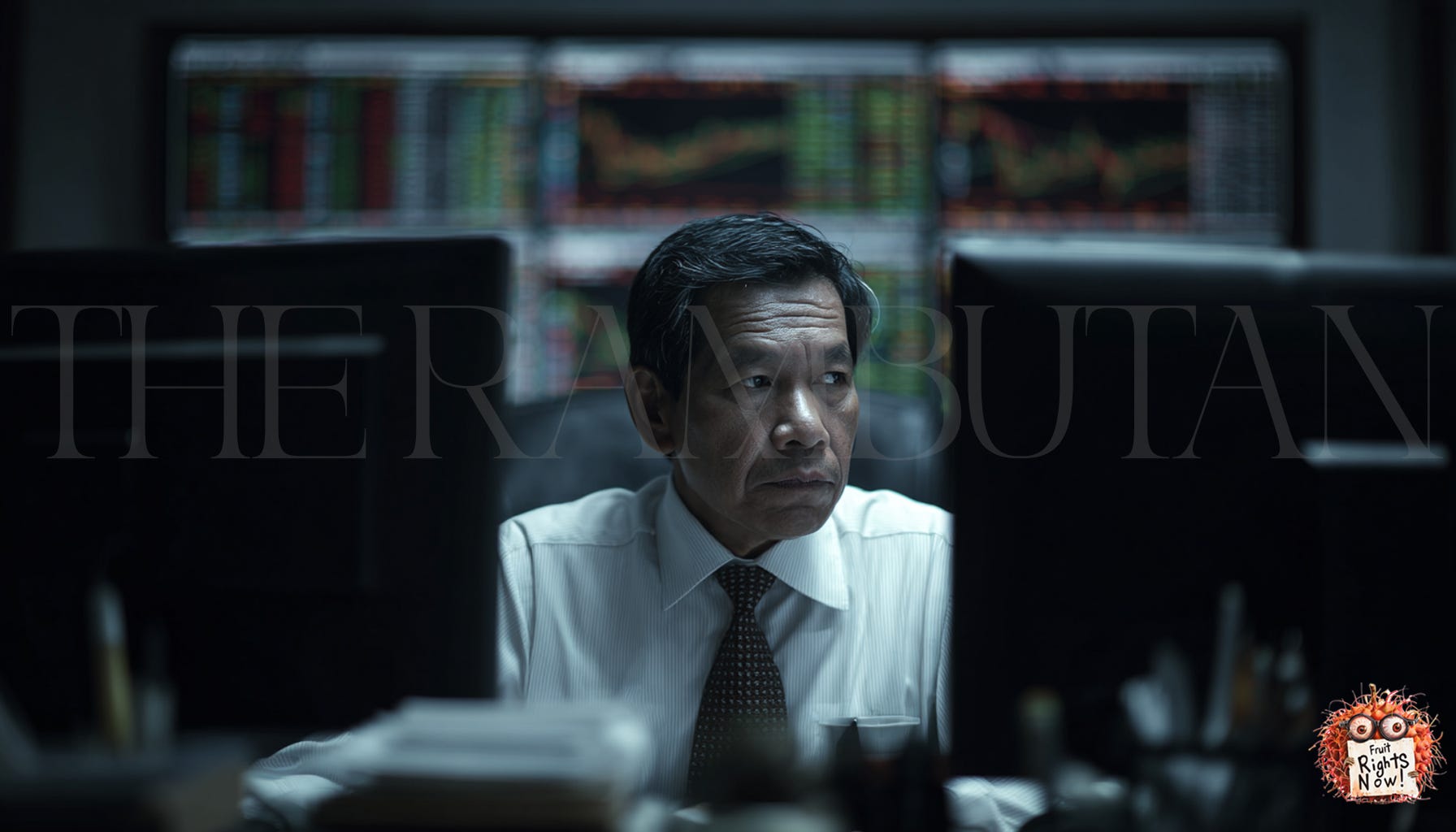
JAKARTA — The Indonesia Stock Exchange (IDX) today announced the launch of its most innovative financial instrument to date: Theoretical Liquidity Futures (TLFs), allowing investors to speculate on the future existence of tradable volume in currently illiquid stocks.
Market participants were cautiously optimistic.
“It’s like buying an option on a dream,” said the CIO of an offshore hedge fund, “except with less regulatory certainty.”
The product will initially be offered across a select group of stocks that meet the exchange’s proprietary “Not Quite Tradable” criteria: listed, real, legally solvent, but impossible to exit without calling someone first.
Unlike traditional equity instruments, Theoretical Liquidity Futures do not require the underlying asset to exhibit any current signs of volume, depth, or bid-side interest. In fact, many of the eligible securities haven’t traded in over 72 hours. This, according to IDX officials, is precisely what makes the product so visionary.
“With TLFs, we’re freeing investors from the constraints of today’s market realities,” said an IDX spokesperson. “Why settle for existing liquidity when you can position for what may eventually be possible under entirely hypothetical conditions?”
The futures will settle physically or be rolled forward indefinitely into new contracts for a small fee.

Institutional investors have long struggled with exposure to thinly traded Indonesian stocks. Now, instead of avoiding them, they can simply hedge that risk by doubling down on it through an even more speculative layer of abstraction.
“This is groundbreaking,” said a domestic pension fund analyst. “I used to be worried about not being able to exit our mid-cap positions. Now I can’t exit and I have futures on my inability to exit. It’s very meta.”
Each contract will come with a built-in “Volume Realization Multiplier” (VRM), which determines the ratio of theoretical volume to actual tradeable volume. IDX clarified that VRM values will be disclosed retroactively, at a future date yet to be scheduled.
Retail investors are also expected to benefit from the new product, provided they can pass a 64-page suitability test and sign a waiver acknowledging that the underlying asset may never actually become liquid within their lifetime.
Following the success of the initial rollout, IDX is already developing a second tier of instruments called Conditional Matching Rights (CMRs), synthetic derivatives that allow investors to claim the right to match future orders in stocks that may one day graduate from the Full Call Auction regime.
IDX is also rumored to be in talks with the Ministry of Finance to classify TLFs as “tax-deductible,” citing their role in stimulating optimism in a challenging global environment.
Critics, however, say the new futures are a distraction from the real issues plaguing the market: low free float, poor secondary liquidity, and companies listing without any actual desire to be traded. IDX has rejected this criticism as “deeply discouraging,” noting that actual liquidity is not a precondition for modern financial innovation.
“At some point we must ask ourselves,” said one official, “isn’t belief in future volume more important than present reality?”
We write the headlines that haven’t happened yet, but probably will. Subscribe to The Rambutan for Southeast Asia’s sharpest fake news.