


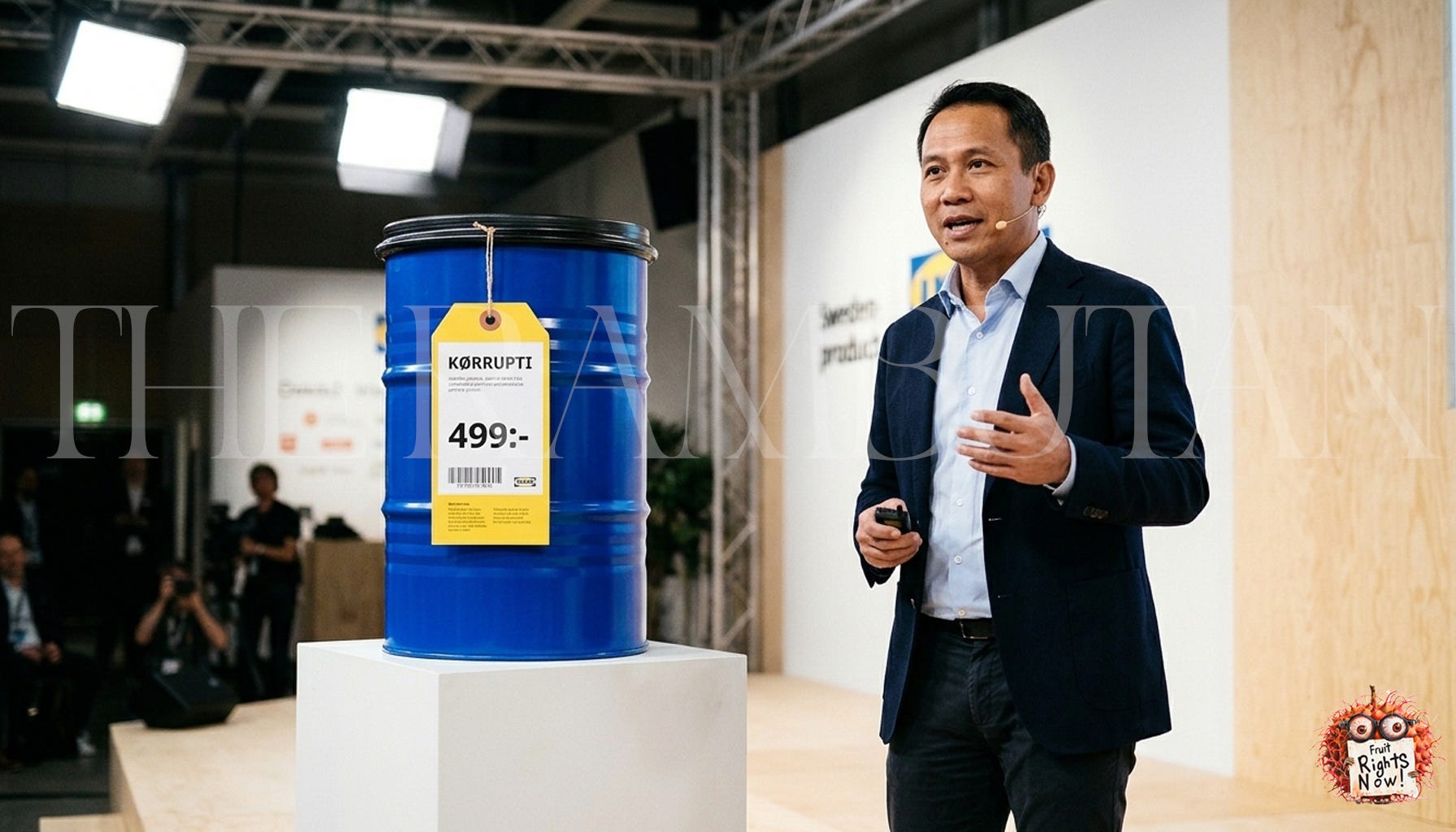
ÄLMHULT, SWEDEN — Seeking to solve the everyday spatial challenges of modern civic governance, Swedish home-furnishings giant IKEA announced its latest breakthrough this week: the KØRRUPTI, a heavy-duty cobalt blue storage barrel engineered specifically to hold exactly two billion rupiah in rubber-banded, non-sequential banknotes.
The release comes after intensive field observations in Indonesia, where product researchers discovered that regional bureaucrats were struggling with sub-optimal, unstandardized storage solutions during routine administrative audit seasons.
“At IKEA, we believe the home and the municipal office should be sanctuaries of peace, efficiency, and quiet utility,” said Torbjörn Lindqvist, IKEA’s Senior Vice President of Civic Storage Solutions. “For too long, public servants have been forced to cram project kickback funds into inadequate, easily ripped cardboard wafer boxes, flimsy luxury shopping bags, or dusty drop-ceiling panels. With KØRRUPTI, we are bringing classic Scandinavian minimalism to the tradition of regional discretion.”
The KØRRUPTI—retailing for a competitive Rp 499,000 and flat-packed to fit neatly in the back of an official government-issue Toyota Innova, is cast from high-density, food-grade polyethylene. Designed in Älmhult with the specific dimensions of Rp 100,000 notes in mind, the barrel eliminates what Swedish designers described as “structural dead space.”
“Our team measured the volumetric footprint of two hundred standard bank bricks,” explained lead industrial ergonomist Freja Nyström. “If a regional regent or procurement chief simply drops the notes in haphazardly, you get air pockets. Air pockets are the enemy of efficiency. KØRRUPTI features subtle internal groove-guides that encourage optimal horizontal stacking, ensuring you reach the Rp 1.95 billion threshold with room left over for an airtight moisture-absorbent silica pack and a single thumb drive containing deleted tender documents.”
In keeping with IKEA’s signature aesthetic, the barrel comes with a wordless, cartoon-illustrated instruction manual. The iconic wooden figure is depicted carefully assembling the barrel with an Allen wrench, using his knees to snap the airtight silicone gasket into place, and finally sliding the finished container discreetly behind a mop bucket in a municipal broom closet while an auditor glances out the window.

The debut has already generated enthusiastic reviews from municipal planning departments and local budget syndicates across Java.
“Before KØRRUPTI, we were improvising with old paint buckets and vintage travel luggage,” noted one municipal procurement official. “Luggage has zippers, and zippers fail when you exceed Rp 1.2 billion. Plus, a leather Samsonite case in a regional water-resources office attracts suspicion from non-governmental watchdogs. But a plain blue plastic barrel? It looks like floor wax. It looks like domestic industrial supplies. It respects the workplace.”
IKEA market research revealed that the transition from old-school brown envelopes to large-capacity industrial plastics has accelerated nationwide. With the rising cost of municipal infrastructure projects and escalating election logistics, the physical volume of Indonesian currency required to expedite local signatures has outpaced traditional office stationery.

Despite the barrel’s utilitarian purpose, IKEA has refused to compromise on its corporate sustainability benchmarks. The KØRRUPTI is manufactured using 45 percent ocean-bound recycled plastic collected from maritime shipping lanes, allowing regional leaders to fulfill municipal green-energy pledges even while accepting illicit cash transfers from road contractors.
“Just because a transaction violates basic transparency laws does not mean it has to leave a heavy carbon footprint,” Lindqvist explained. “We must separate compliance from ecological stewardship.”
Even national anti-corruption investigators have offered praise for the product’s standardized dimensions. Speaking off the record, a field operative with the Corruption Eradication Commission (KPK) admitted that standardized containers significantly accelerate the evidence-seizure process.
“When we conduct a dawn raid and find money stuffed inside sofa cushions, and multiple brands of laundry hampers, our forensics team has to spend six hours inventorying disparate containers before the press conference,” the agent said. “A standard KØRRUPTI drum saves us valuable administrative time. We look at the fill line and instantly write down ‘approx. Rp 1.9 billion’ on the evidence tag.“
The KØRRUPTI is expected to hit Indonesian showroom floors this weekend, positioned in the catalog’s popular “Home Organization & Regional Governance” aisle, alongside the UPETI modular divider trays and the VONIS sound-dampening acoustic privacy panels.
We write the headlines that haven’t happened yet,but probably will. Subscribe to The Rambutan for Southeast Asia’s sharpest fake news.