


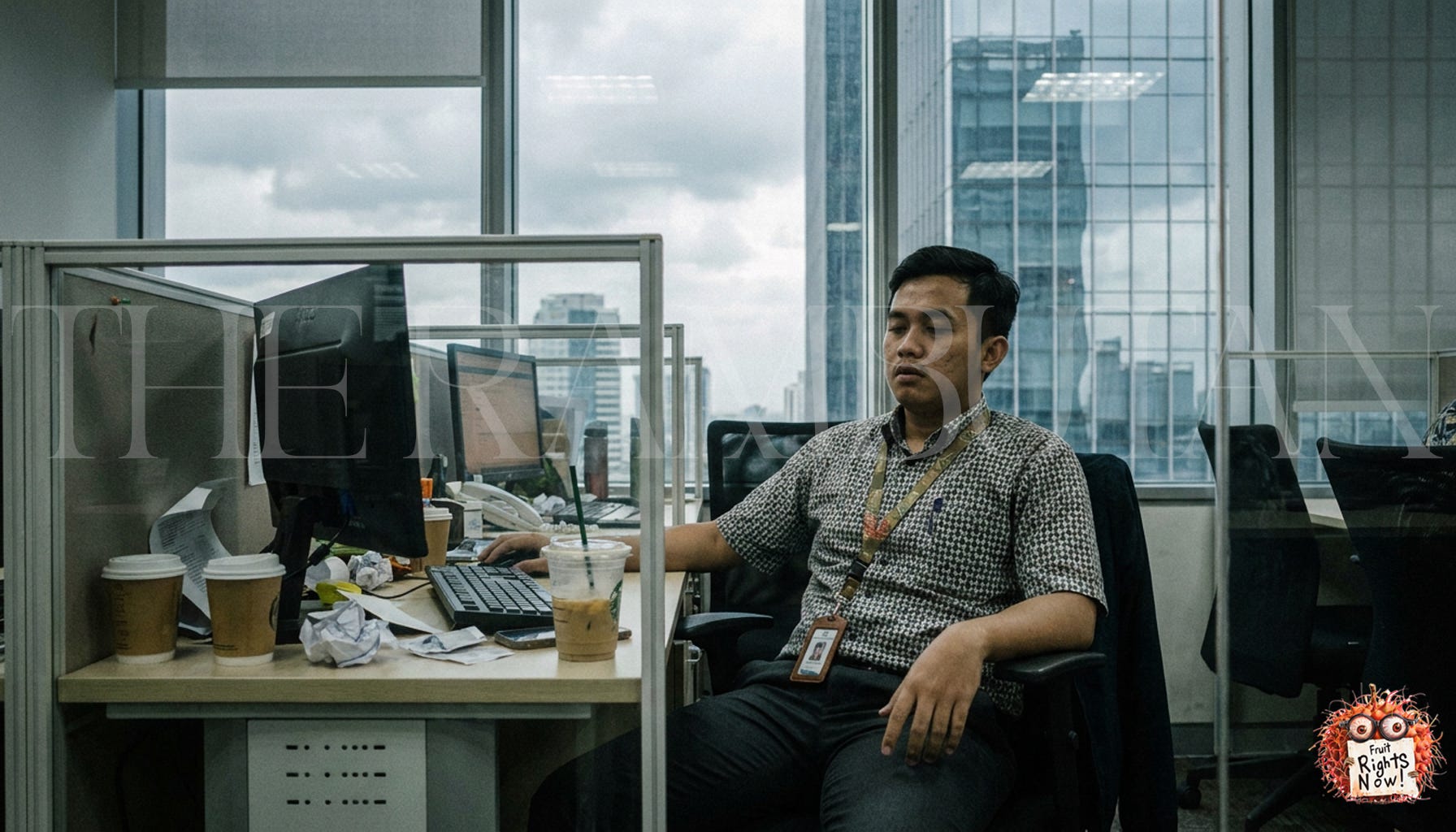
JAKARTA — Following an emergency audit of the official ministerial decree on joint holidays (SKB 3 Menteri), calendar analysts confirmed what millions of corporate employees had dreaded since late August: the Republic of Indonesia has entered an unprecedented, barren three-month period entirely devoid of a single tanggal merah (national public holiday) until Christmas Day.
The announcement has triggered widespread despair across Sudirman Central Business District (SCBD), where thousands of lanyard-wearing knowledge workers were seen staring into their third iced palm sugar lattes, calculating that they must now endure sixteen consecutive, unbroken five-day workweeks.
Unlike the holiday-dense paradise of May, where public holidays routinely fell on Tuesdays and Thursdays, the autumn months of 2026 offer no such reprieve.
“I zoomed out on my Google Calendar until my monitor ran out of pixels, thinking surely there must be a regional election, or an obscure administrative observance somewhere in October,” said Reza Pratama, 28, a Senior Associate at a tech conglomerate in Mega Kuningan. “There is nothing. Just black numbers.”
The crisis has reverberated across modern lifestyle hubs. High-end coffee shops in Senopati reported a sharp decline in discussions about quarterly ROI, replaced entirely by hushed whisper networks sharing tips on how to feign illness over Zoom.

With annual leave quotas largely exhausted during the long Eid and August getaways, personnel directors are bracing for a surge in fraudulent sick leave notices (surat sakit) and unverifiable domestic emergencies.
“Our predictive algorithms are already flashing crimson,” explained Dewi Lestari, Chief People Officer at an infrastructure consulting firm in Central Jakarta. “Historically, during a three-month red-date drought, an employee’s extended family tree experiences a mortality rate roughly six hundred percent higher than the national average.”
“We currently have three separate junior copywriters whose maternal grandmothers have tragically passed away for the fourth time since 2024,” Dewi continued. “We are also preparing for an outbreak of ‘acute gastrointestinal stress’ that strangely only manifests on Friday mornings before long-haul flights to Labuan Bajo.”

As the reality of an unbroken ninety-day grind settles into the national consciousness, labor activists and white-collar union representatives have launched a campaign demanding state intervention to bridge the calendar void.
The Coalition of Knowledge Workers held a press conference outside the Ministry of Manpower on Thursday, demanding the immediate drafting of an emergency decree instituting several substitute holidays.
“The government cannot expect a workforce to function for three straight months without an arbitrary day off to sit in traffic on the Jagorawi toll road,” proclaimed union chairman Bambang Supriyadi. “If the state refuses to provide us with a tanggal merah, the people will be forced to manufacture their own through quiet quitting, prolonged bathroom breaks, and three-hour lunch meetings at Grand Indonesia.”
When asked for comment, a spokesperson for the Ministry of Manpower expressed deep empathy for the nation’s workforce, reminding citizens that while there are indeed zero holidays scheduled between September and December, employees are invited to look at pictures of past long weekends during their designated twelve-minute screen breaks.
We write the headlines that haven’t happened yet, but probably will. Subscribe to The Rambutan for Southeast Asia’s sharpest fake news.