


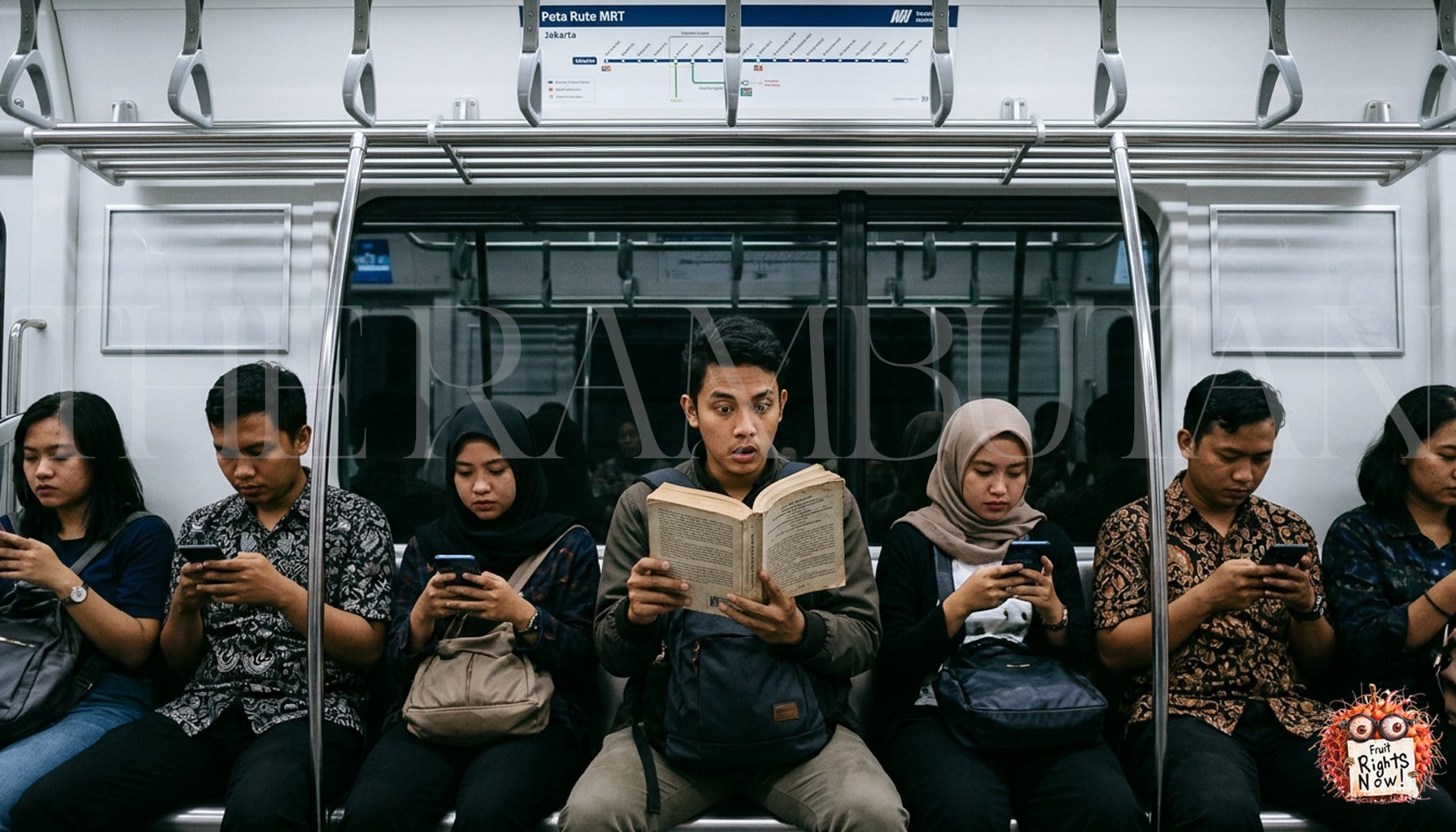
JAKARTA — The republic was plunged into crisis on Wednesday following the revelation that Paradoks Indonesia, the hefty, matte-finished paperback that has spent the better part of seven years serving as a chic coaster in the nation’s upscale living rooms, actually contains written words intended for human consumption.
The revelation sent shockwaves across South Jakarta, where millions of citizens are now struggling to come to terms with the fact that alphabetical characters, when arranged in sequential order, can form binding blueprints for state-directed macroeconomic restructuring.
The crisis began early Monday morning in a Scandinavian-style café in Senopati, where 29-year-old venture capital associate Kevin Hartono accidentally knocked the 300-page manifesto off a reclaimed-teak coffee table.
“Usually, it just sits right between the imported Aesop hand balm and the soy-wax candle,” Hartono told reporters. “Its sole purpose for the last five years has been to signal to my houseguests that I have a nuanced, intellectual relationship with post-colonial sovereignty without me actually having to know what a sovereign does. But when it fell, it popped open to page 142. And guys… there weren’t pictures. There were sentences. About sovereign wealth mobilization. And state-managed supply lines.”
Within hours, corporate analysts across the Sudirman Central Business District (SCBD) were dusting off their own copies, which had previously been employed to prop up wobbly dual-monitor setups, or flatten dried botanicals.
“We assumed it was just high-density cardboard meant to anchor the room’s neutral color palette,” admitted Michelle Wijaya, an ESG consultant who had kept a signed 2019 edition prominently displayed next to her Monocle travel guides. “If we had known the book contained an explicit, step-by-step master plan to subordinate private capital to palace-directed industrial champions, we never would have matched it with our beige linen couch.”

The discovery has triggered outrage among the nation’s younger demographic, who voted overwhelmingly for the administration after being enchanted by viral TikTok clips of a cuddly, pastel-blue-clad grandfather executing adorable shuffle dances with stray cats.
Many voters are now accusing the government of an egregious breach of democratic etiquette by actually implementing the exact policies written on the pages.
“This is classic bait-and-switch,” said 22-year-old digital content creator Dimas Pratama. “The campaign delivered high-tempo pop remixes, and cute cartoon stickers of a chubby grandpa. But then you flip open Chapter Four, and it’s just eight solid pages railing against the Washington Consensus, demanding autarkic food estates, and mourning the death of the 1950s agrarian cooperative. There wasn’t even a split-screen video of mobile gameplay at the bottom of the page to help me process the prose. How was anyone under thirty supposed to know this was real?”
Political marketing consultants have rushed to defend themselves against accusations of strategic concealment, insisting that leaving a candidate’s true platform inside a 300-page printed physical book remains the most foolproof method of keeping it completely secret from the modern electorate.
“We didn’t hide anything,” said one senior campaign strategist on condition of anonymity. “In fact, we placed the manifesto in the front display window of every major bookstore chain for seven consecutive years. We priced it at a modest 85,000 rupiah. We knew with absolute, mathematical certainty that not a single member of the voting public or the financial press would ever commit to cracking the spine and reading the text. If you want to keep an ideological revolution confidential in the 21st century, you just bind it in a paperback.”

In response, major private equity firms and commercial banks have suspended all normal underwriting activities to conduct remedial literacy workshops for their senior leadership.
“Our entire senior investment committee has spent the last forty-eight hours sounding out multi-syllable words like di-ri-gisme and pre-ben-dal,” explained one exhausted hedge fund manager. “We previously assumed the President’s constant references to ‘Article 33’ were just an edgy streetwear reference or a VIP table reservation code at an upscale lounge. It turns out it’s a clause in the constitution that allows the state to seize the commanding heights of the economy. We are completely out of our depth.”
Meanwhile, the palace has remained entirely unmoved by the panic, with officials gently reminding the public that every tax audit, centralized community kitchen franchise, export ban, and below-market sovereign debt instrument currently rolling across the republic was outlined in the table of contents under the heading “Things We Are Definitely Going to Do.”
At press time, corporate executives were seen raiding local libraries, desperately attempting to determine whether any other sitting politicians had ever committed thoughts to paper, while several tech CEOs announced plans to safely replace their copies of Paradoks Indonesia with an unread biography of Steve Jobs, which they are confident will have no direct impact on national tax policy.
We write the headlines that haven’t happened yet but probably will. Subscribe to The Rambutan for Southeast Asia’s sharpest fake news.