


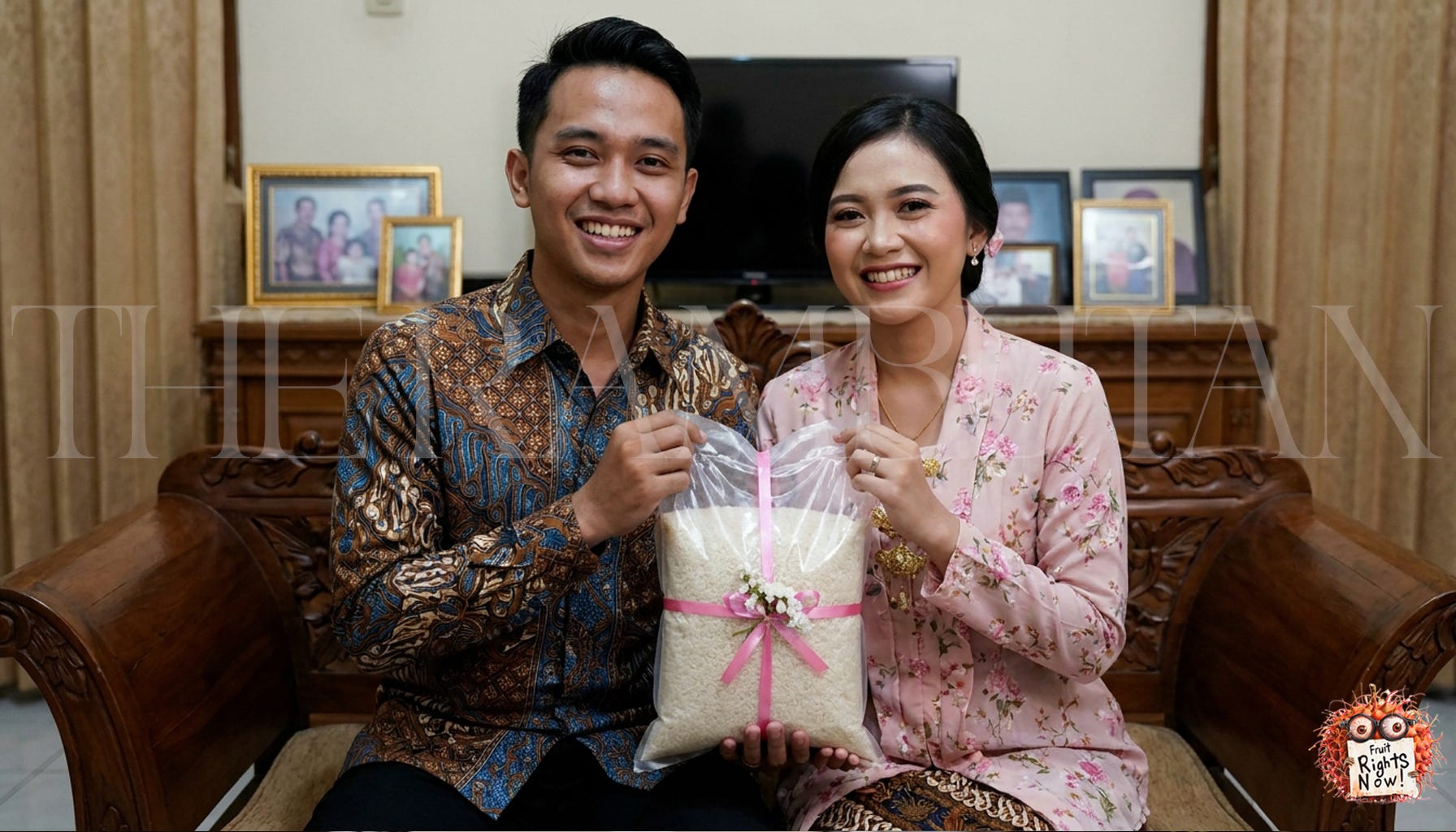
DEPOK, WEST JAVA — 27-year-old software engineer Agus Setiawan successfully secured his betrothal this week after dropping to one knee and presenting his prospective bride with a vacuum-sealed 5-kilogram sack of premium Pandan Wangi rice.
The romantic gesture came just days after official data revealed that national year-on-year inflation accelerated to 3.19%, driven overwhelmingly by volatile food staples and wild fluctuations in global precious metals.
“Ratna, gold is a speculative bubble subject to geopolitical whims, but these aromatic long-grain carbohydrates represent real, consumable wealth,” Agus whispered while gazing into the eyes of his girlfriend, Ratna Sari, 25. “A 24-karat ring cannot sustain cellular life during a sudden supply-chain disruption. Will you hedge against market volatility with me?”
Ratna, visibly moved to tears by the romantic practicality of the gesture, instantly said yes.
The proposal was endorsed by Ratna’s father, Pak Bambang (58), a retired civil servant and neighborhood RT head.
According to family members, Pak Bambang approached the table, put on his reading glasses, and inspected the sack. He sliced open a microscopic corner of the packaging, extracted three grains, and bit down on one to test its moisture content.
“A young man offering gold is thinking only of vanity, but a young man offering five kilograms of Grade-A polished rice is thinking of breakfast, lunch, and dinner,” Pak Bambang told reporters. “You can’t shave flakes off an Antam bar and boil them in coconut milk to make Nasi Uduk. In the event of a total macroeconomic collapse, a necklace is just a very heavy, inedible choker. This boy understands asset liquidity.”

Financial planners in South Jakarta have been quick to praise Agus’s forward-thinking approach, noting that staple food crops currently offer a far better return on investment (ROI) than traditional precious metals.
“Gold prices are at historical highs, meaning the downside risk for young grooms is immense,” explained Hendra Gunawan, a certified financial planner and managing partner at a boutique capital firm in SCBD. “If you buy an engagement ring at peak pricing and the market corrects by 12% next month, your marriage is immediately in the red. But rice? Rice possesses utility value. Even if the global market drops, the caloric yield remains exactly 3,600 calories per kilogram. It is the ultimate non-depreciating, consumable hedge.”
Local commodity traders at Pasar Induk Kramat Jati confirmed they have received inquiries from nervous bachelors attempting to lock in six-month futures contracts on red chili peppers before meeting their prospective in-laws for dinner.

Despite the unorthodoxy of the gift, the newly engaged couple spent the remainder of Sunday afternoon staging an aesthetic engagement photoshoot for Instagram.
Ratna stood beside the 5kg sack, gently resting her hand on its sturdy stitched seam while sunlight poured through the window, accentuating the vibrant green “PANDAN WANGI SUPER” logo printed across the front. The post has already garnered over 40,000 likes, with hundreds of women tagging their boyfriends.
“My friends all received rings that sit in velvet boxes inside a bedroom drawer because they’re terrified of getting mugged on the commuter line,” Ratna said. “Meanwhile, my fiancé gave me security and approximately 35 hearty portions of steamed rice. That is true romance.”
When asked whether he plans to supplement the wedding ceremony with traditional jewelry next year, Agus shook his head, noting that his risk tolerance remains strictly conservative.
“For the actual wedding day, I’m looking at diversifying into a 25-kilogram sack of medium-grain rice and perhaps a small, high-yield canister of subsidized LPG gas,” Agus said. “If you truly love a woman, you don’t give her something that just glitters under a spotlight.”
We write the headlines that haven’t happened yet, but probably will. Subscribe to The Rambutan for Southeast Asia’s sharpest fake news.