


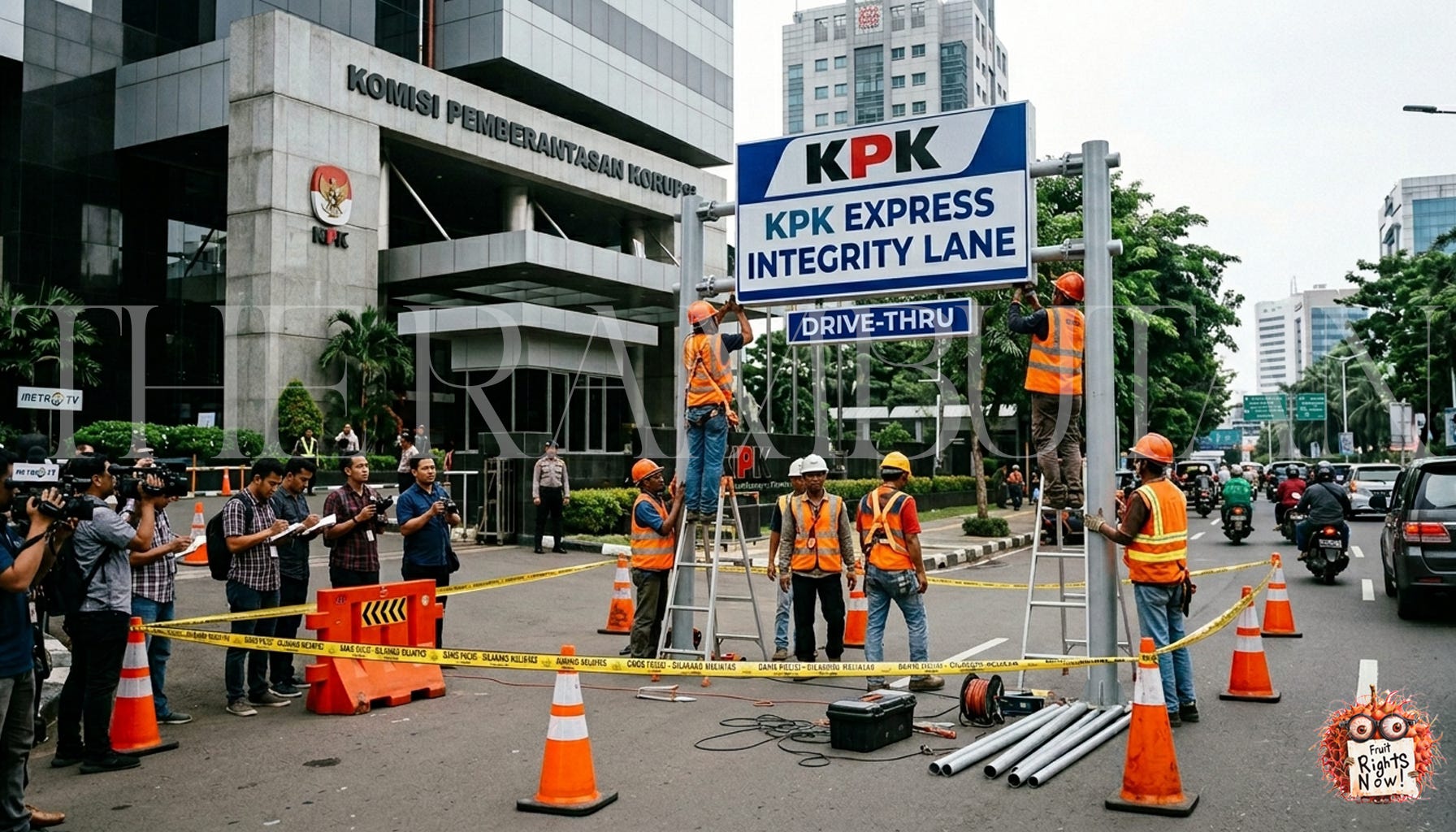
JAKARTA — The Corruption Eradication Commission has confirmed it will begin construction on a dedicated drive-thru processing lane after a surge of government officials arriving for “friendly discussion,” and other forms of legally inconvenient hospitality.
The new facility will allow public officials to remain in their vehicles while presenting documents, surrendering phones, and giving the traditional public statement that they are “fully cooperative” and “certain this is all just a misunderstanding.”
“Due to recent demand, our lobby was no longer able to accommodate the volume of public servants seeking clarification about why their names keep appearing in corruption investigations,” said a KPK spokesperson. “We realized we had two choices: either reduce corruption or improve traffic flow. Naturally, the second option was more immediately achievable.”
Under the proposed system, an official entering the facility will first approach an automated ticket dispenser. The machine will ask whether the visitor is arriving as a witness, suspect, former official, current official, business associate, or procurement consultant.
After selecting the appropriate category, the official will proceed to Window One, where investigators will verify identity, and collect phones.
At Window Two, visitors will receive a summons letter, or a corruption-prevention brochure depending on the severity of the case and the quality of their opening statement.
Window Three will be reserved for what insiders call “the ceremonial handover,” in which officials are invited to step out of their vehicles, adjust their vests, and walk slowly past the press while looking both humble and surprised.

The decision follows what employees describe as an unusually busy week at KPK headquarters.
Witnesses said several men in batik shirts were seen comparing legal teams in the waiting area, while one former official attempted to reserve a spot in line using a stack of procurement invoices.
“At first we thought it was a delegation,” said one security guard. “Then we realized they were all here separately, but somehow everyone had the same sentence prepared: ‘I respect the legal process and ask the public not to speculate.’”
By midday, the overflow had extended into the parking lot, where officials were seen rehearsing camera-facing expressions ranging from “deeply wounded public servant” to “man who has just remembered he owns seven houses.”
The public reaction has been largely positive, with many Indonesians praising the drive-thru lane as a long-overdue modernization of the nation’s anti-corruption ecosystem.
A spokesperson emphasized that the drive-thru lane should not be interpreted as evidence that corruption is increasing.
“This is not about quantity,” he said. “This is about service quality. Whether we process five officials or fifty officials in a day, every citizen deserves to know that accountability is being handled with speed, and professionalism.”
When asked whether the agency feared the new lane might normalize corruption, the spokesperson shook his head.
“On the contrary,” he said. “Nothing says ‘we are serious about reform’ like building permanent infrastructure for the predictable arrival of corrupt officials.”
We write the headlines that haven’t happened yet, but probably will. Subscribe to The Rambutan for Southeast Asia’s sharpest fake news.