


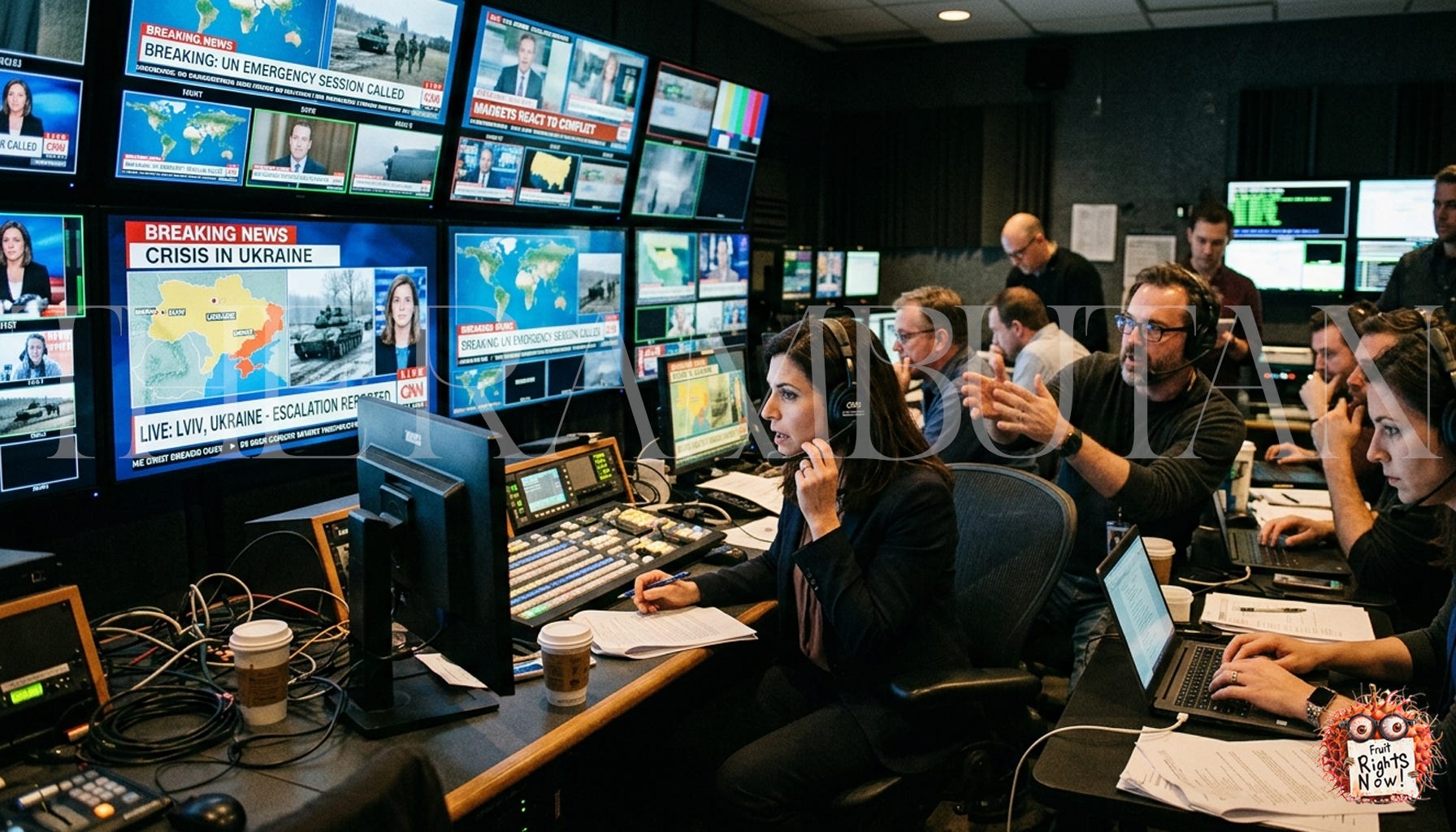
WASHINGTON, D.C. — A newly proposed Middle East peace agreement has sparked concern across the cable news industry this week, as experts warned that any meaningful reduction in international conflict could severely disrupt the programming schedules of major American news networks.
“This is a very fragile moment,” said Dr. Caroline Voss. “A peace deal of this magnitude could have serious consequences for the outrage ecosystem. Networks have spent years building graphics packages, and panel rotations around the assumption that something is always on fire. Peace threatens that entire business model.”
Industry insiders say producers were particularly alarmed by early reports that diplomats had used phrases such as “de-escalation,” “long-term stability,” and “mutual framework,” all of which tested poorly with viewers compared to phrases like “breaking point,” “powder keg,” and “World War III?”
The concern appears to be bipartisan. Liberal networks fear peace could reduce opportunities to blame the administration, while conservative networks fear peace could reduce opportunities to blame the previous administration. Centrist networks, meanwhile, are reportedly unsure how to cover peace without assembling a panel of seven people who all agree the situation is “complicated.”
Media consultants say the emotional tone of cable news has become so dependent on active conflict that even a modest diplomatic breakthrough could prove disorienting.
“For years, anchors have been trained to lower their voices, lean toward the camera, and ask if America is prepared for what comes next,” said Marcus Delaney, a broadcast strategy consultant. “But if what comes next is a negotiated framework with monitoring provisions, nobody knows how to fill the B-block.”

Think tanks across Washington have reportedly begun preparing white papers on how to preserve television opportunities during peacetime.
“That’s the key,” explained Voss. “You never say, ‘Things may be improving.’ You say, ‘Some experts warn apparent improvement could mask deeper instability.’ That way, everyone can keep their jobs.”
Meanwhile, foreign policy guests have begun repositioning themselves. One longtime regional analyst updated his professional bio from “war expert” to “post-conflict volatility expert,” while another announced a forthcoming book titled The Dangerous Instability of Stability.
Bookers say the transition has been difficult but manageable.
Perhaps the greatest concern among media executives is that a reduction in foreign crisis coverage could force networks to devote airtime to issues affecting Americans directly.
“People say they care about the debt,” said one network executive. “But have you ever tried putting a debt clock on screen for 12 minutes? It’s just numbers getting worse. It’s devastating television.”
Public reaction to the potential shift has been mixed. Some viewers welcomed the possibility of less war coverage, while others expressed concern that they might accidentally learn how local government works.
At press time, network executives were reportedly relieved after one diplomat cautioned that the peace agreement remained “fragile,” allowing anchors nationwide to resume using their serious voices and asking whether the world was once again standing at the edge of a dangerous new phase.
We write the headlines that haven’t happened yet, but probably will. Subscribe to The Rambutan for Southeast Asia’s sharpest fake news.