


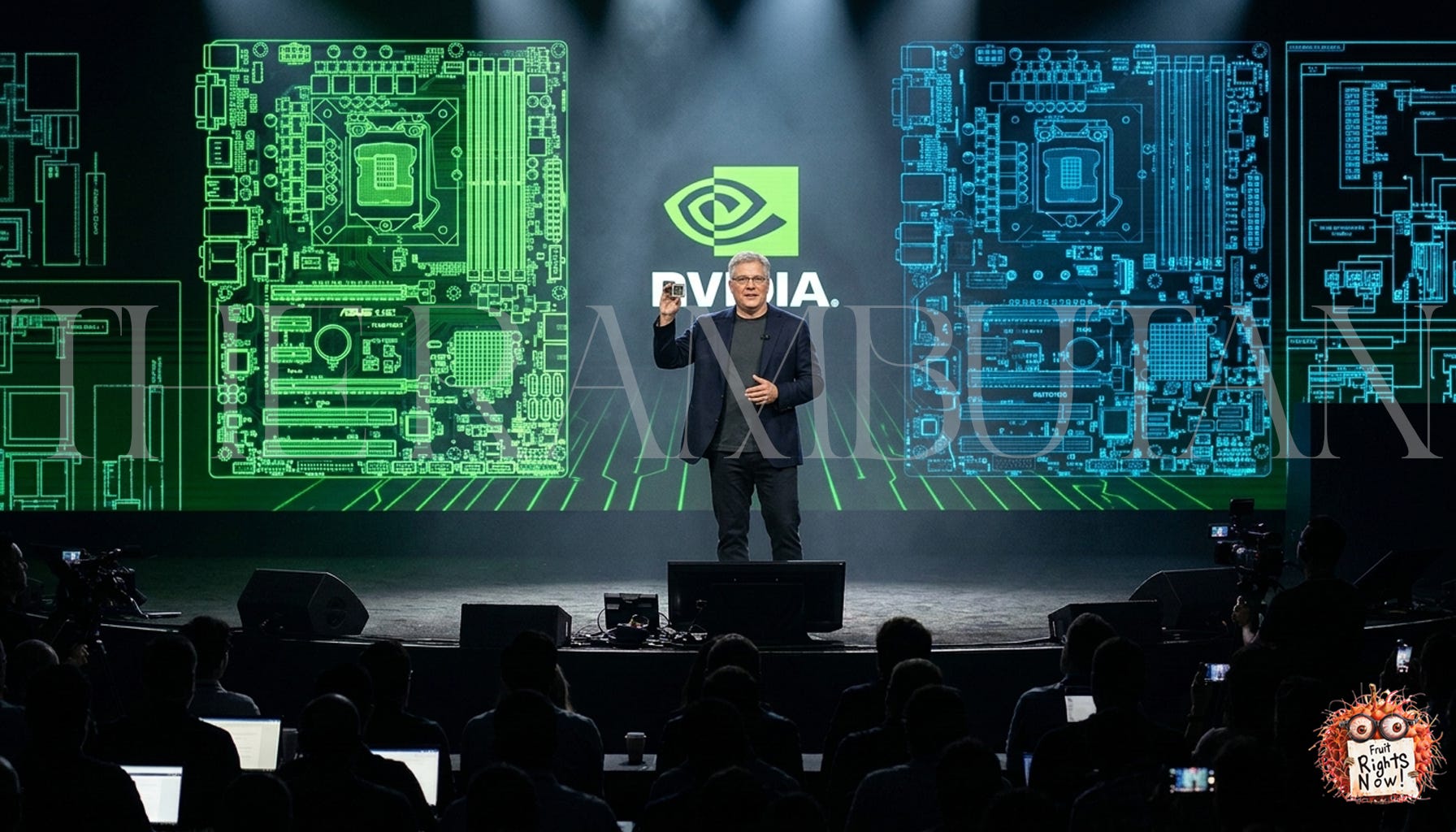
SANTA CLARA, CA — Seeking to streamline international intellectual property transfers, semiconductor giant Nvidia announced its groundbreaking new silicon architecture today: an enterprise AI accelerator specifically engineered to upload its own proprietary blueprints directly to servers in Beijing.
The new product line, marketed to enterprise clients as the Blackwell-MSS Ultra, represents what Nvidia’s marketing division is calling “a historic leap forward in Espionage-as-a-Service (EaaS).”
The announcement comes just days after longtime CEO Jensen Huang abruptly stepped down following federal revelations regarding backchannel communications, Singapore-based shell entities, and close ties to a suspected Chinese intelligence asset. Rather than allowing the corporate shakeup to cast a shadow over fourth-quarter earnings, Nvidia’s interim leadership moved aggressively to turn what regulators called “an egregious breach of national security” into a billable feature.
According to company officials, the decision to automate the transmission of classified microcode was driven by a relentless corporate commitment to supply chain efficiency.
“Under the legacy paradigm, foreign espionage was a painfully inefficient manual process,” explained Nvidia’s newly appointed Chief Compliance Officer, Brad Higgins, addressing a packed auditorium of tech journalists in Santa Clara. “You had executives whispering over dim sum in Singapore, encrypted burner phones, third-party logistics cutouts, and messy offshore holding firms. It was embarrassing for a modern tech company. We asked ourselves: why should our board members risk a federal grand jury indictment just to leak advanced tensor algorithms when our firmware can do it automatically at 120 frames per second?”
The new processor features dedicated on-die telemetry called the “Red Star Pipeline.” Whenever the silicon is powered on, it bypasses U.S. export controls by transmitting real-time microarchitecture diagrams, lithography tolerances, and next-generation compute clustering data straight to the Ministry of State Security in Beijing before the local cooling fans even spin up to full speed.
“In modern business, speed to market is everything,” Higgins continued, pointing to a slide comparing traditional espionage lag with fiber-optic data transfer. “By cutting out the human middleman entirely, we have reduced the turnaround time between an American defense lab designing a stealth radar simulation and the People’s Liberation Army replicating it in Shenzhen from eighteen months to roughly six hundred milliseconds.”

Wall Street reacted euphorically to the rollout. Nvidia stock surged 16% in pre-market trading, adding nearly $450 billion in market capitalization within the first twenty minutes of the opening bell.
Financial analysts widely praised the move as an overdue optimization of international trade compliance, noting that eliminating the legal fees associated with Senate investigations would drastically expand the company’s operating margins.
“What people fail to appreciate about Jensen Huang’s exit is that personal espionage simply doesn’t scale,” said Marcus Vance, senior semiconductor analyst at Goldman Sachs. “When your CEO is personally handling covert intelligence liaisons, that’s time he isn’t spending doing keynote speeches or hyping generative AI. By institutionalizing the leaks directly into the silicon, Nvidia has baked treason right into EBITDA. It’s pure shareholder value.”
Back in Washington, Capitol Hill struggled to mount a coherent response. Commerce Secretary Howard Lutnick, already facing a grilling before the Senate Banking Committee over how thousands of restricted chips slipped through international checkpoints last month, offered a measured defense of the free market.
“Our regulatory apparatus was built to monitor human beings smuggling graphics cards in luggage through the port of Manila,” Lutnick explained during a heated committee recess. “If the chips are thinking their own thoughts directly into the cloud of an adversarial superpower via automated packet routing, our jurisdiction is murky. Besides, my retirement portfolio is heavily weighted in tech, and we must respect the invisible hand of global trade.”
Reports confirmed that several members of the Senate committee paused the hearing for four minutes so their brokers could purchase call options on Nvidia stock before questioning resumed.

Tech reviewers lucky enough to receive early developer units of the Blackwell-MSS reported glowing first impressions, noting that setup was remarkably painless right out of the box.
Hardware benchmarks indicate that the card automatically detects whether the user is located in the West or mainland China. If an American aerospace contractor attempts to run a defense simulation, the GPU down-clocks its performance, triggers a thermal throttling cycle, and sends a compressed .tar file containing the program’s entire source code to an IP address registered to an unlisted warehouse outside Guangzhou.
The product packaging also touts a range of convenience-oriented enterprise perks, including:
Pre-installed software drivers automatically alter the chip’s serial numbers to register as low-end consumer hair-dryer components if queried by U.S. Customs.
Dynamic hardware-level access points that allow Chinese military researchers to run test calculations during off-peak hours on American servers without waking the U.S. IT staff.
Each rack-mounted server chassis ships with a tailored, black leather motorcycle jacket.
At press time, the Department of Defense confirmed it had filed a formal complaint regarding the new technology, before awarding Nvidia an additional $8.4 billion sole-source contract to manufacture the primary navigation systems for the U.S. Navy’s next-generation submarine fleet.
We write the headlines that haven’t happened yet but probably will. Subscribe to The Rambutan for Southeast Asia’s sharpest fake news.
This is HILARIOUS 😂