


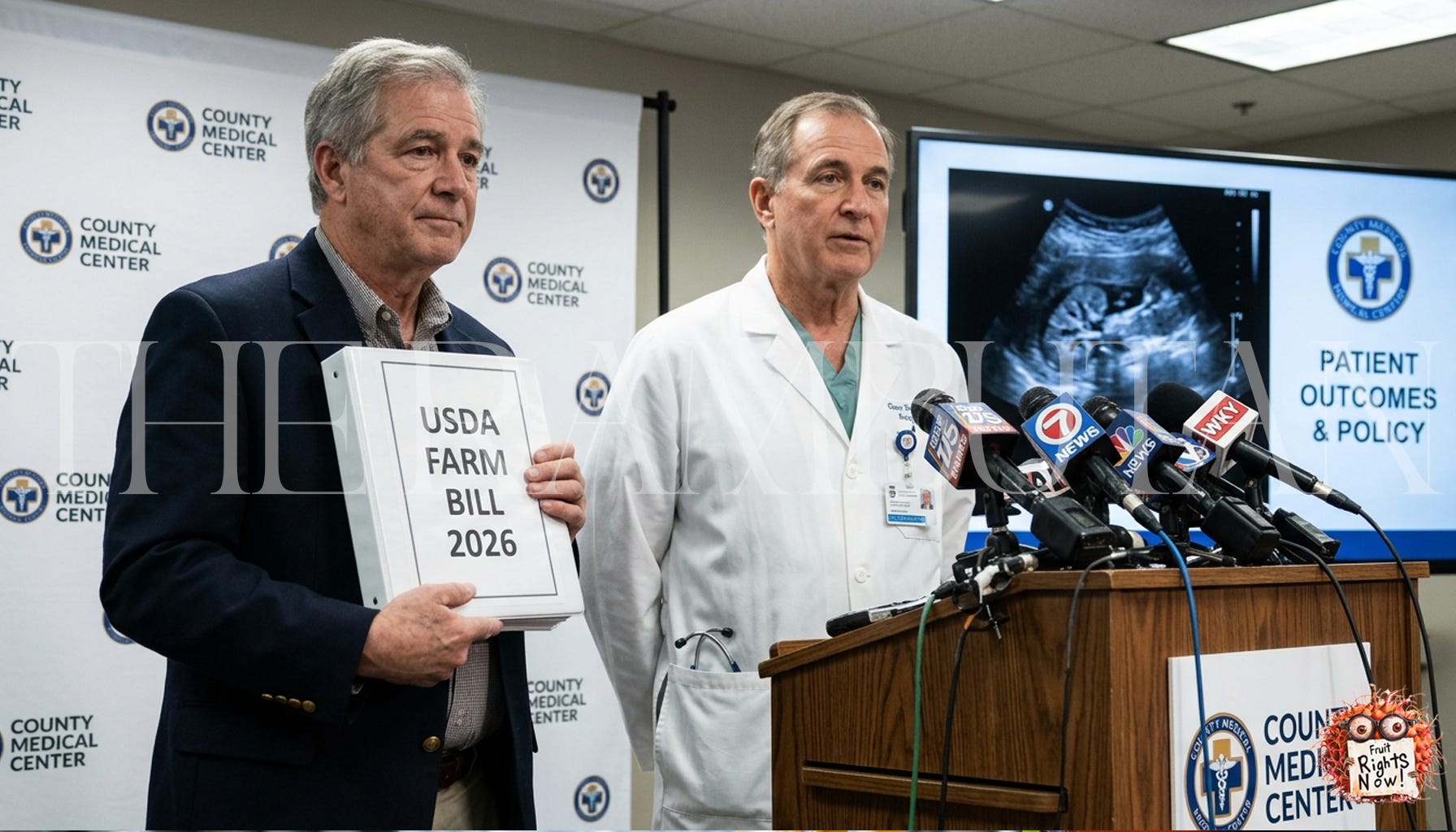
BOSTON, MA — A medical breakthrough at Massachusetts General Hospital has crossed into new territory this week, as doctors confirmed that the world’s first long-term recipient of a genetically modified porcine kidney has reached the one-year survival mark while developing a sudden interest in federal agricultural policy.
Harold “Hal” Jenkins, a 58-year-old retired civil engineer from Framingham, received the gene-edited organ last year in what surgeons hailed as a victory for modern xenotransplantation. While Jenkins’s blood pressure is pristine and his creatinine clearance has confounded medical skeptics, his family reports that the physiological changes have been accompanied by a strong urge to advocate for the National Pork Producers Council.
According to hospital records, Jenkins’s transplanted kidney has performed flawlessly. The organ completely eliminated Jenkins’s need for dialysis within forty-eight hours of implantation.
However, by month six, clinicians began noticing behavioral shifts that were not documented in early clinical trial protocols.
“Biochemically, Mr. Jenkins is a textbook success,” said Dr. Arthur Sterling, chief of surgical xenotransplantation at Mass General. “His vascular integrity is robust, and the anti-rejection regimen has kept host-versus-graft complications virtually non-existent. Now, do we typically see patients suddenly spending three hours an evening reading the regulatory language of the federal Farm Bill? Historically, no.”
Hospital staff first noted the anomalies during a routine nine-month follow-up. When asked to evaluate his general pain on a standard scale from one to ten, Jenkins reportedly grunted, demanded the hospital cafeteria stop serving Canadian bacon, and submitted a memorandum urging the Department of Agriculture to expand corn-price deficiency payments to Midwest family farms.
Dr. Sterling noted that while science cannot strictly prove that twenty square centimeters of porcine renal tissue can transmit deep-seated geopolitical sympathies regarding hog-raising tax write-offs, the hospital’s research team has refused to rule it out. “He is showing an unprecedented affinity for ethanol subsidies,” Sterling admitted. “We consider it a minor tradeoff for glomerular restoration.”

At home, Jenkins’s wife of thirty-two years, Brenda, says she has done her best to adapt to the new normal, though the transition has not been without difficulty.
“Right after the surgery, Hal was just thrilled to have his energy back,” Brenda told reporters. “Then came the changes. First, he canceled our Sunday paper and replaced it with a monthly subscription to National Hog Farmer and Swine Web Weekly. Next, he started lingering by the lawn sprinklers after heavy rainstorms, staring at the soft soil. Last week, I found him lying on his side in the garden behind the hydrangea bushes. He told me he was ‘regulating his core temperature,’ but he was just wallowing.”
The behavioral changes have also strained family meals. Jenkins has taken to vocalizing his displeasure with snorts whenever Brenda prepares roasted poultry or turkey sausage.
“I bought turkey bacon because his cardiologist said we needed to watch his sodium,” Brenda explained. “Hal took one look at the frying pan, let out a squeal, and slapped the spatula clean across the kitchen. He looked me in the eye and said, ‘If you’re going to desecrate breakfast, woman, at least use a real beast of the soil.’ Then he demanded a bowl of wet mash and went back to checking the Chicago Board of Trade hog futures on his iPad.”

Biotech researchers at the Massachusetts Institute of Technology, who designed the genetically altered porcine donor, have downplayed the incident, emphasizing that human genome integration is an evolving frontier.
“Whenever you introduce foreign tissue into a mammalian host, there is a complex neurological dialogue,” explained Dr. Evelyn Vance, head of transgenic bio-behavioral studies. “The engineered pig kidney retains cellular memory. The donor animal’s lineage spent generations appreciating state-subsidized communal housing with guaranteed grain distribution. It makes sense that Hal would instinctively identify with the political platform of Iowa Senator Chuck Grassley.”.
When asked whether he felt uncomfortable with his new political convictions, Jenkins remained unapologetic.
“People say I’ve changed, but I just see the world with newfound clarity,” Jenkins told reporters from his back patio. “This nation was built on the backs of hardworking swine and cheap domestic corn silage. If Washington politicians think they can cut environmental livestock exemptions without hearing from voters like me, they’ve got another thing coming.”
We write the headlines that haven’t happened yet but probably will. Subscribe to The Rambutan for Southeast Asia’s sharpest fake news.