


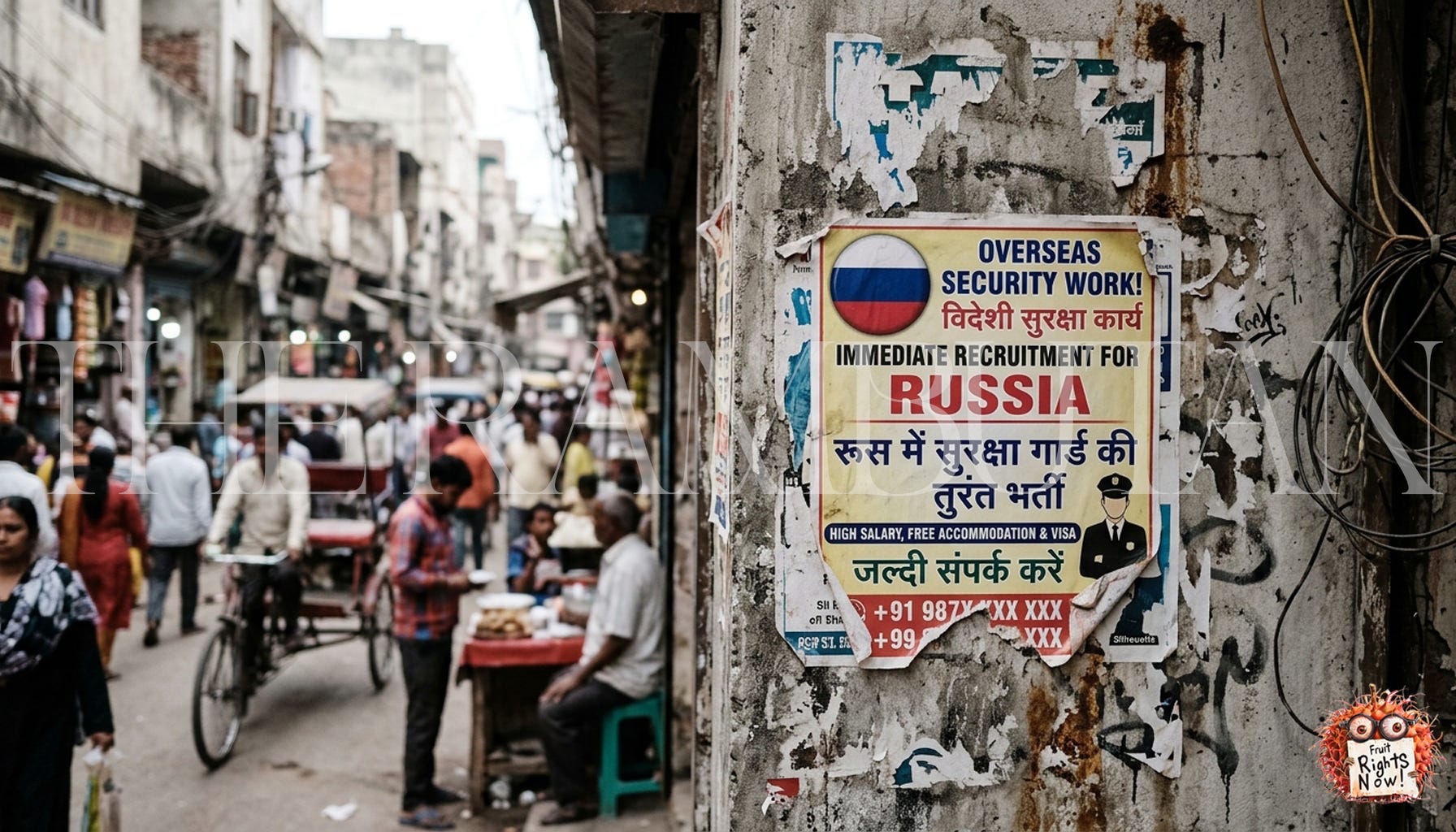
MOSCOW — Defense Ministry foreign talent acquisition managers expressed regret Thursday over a “minor clerical oversight” on hundreds of thousands of employment brochures distributed across India, Nepal, and Sri Lanka, having neglected to include an asterisk clarifying that the position frequently results in being obliterated by a quadcopter drone.
The mistake came to light this week after leaked internal figures from state statistics agency Rosstat revealed that over 11,000 foreign citizens recruited through agencies had successfully completed their service terms by ascending into the Slavic afterlife.
Following the leak, military ombudsmen conducted a review of the promotional flyers, discovering that while headlines promised “Exciting Foreign Travel,” “Free Room and Board,” and “Competitive Ruble-Denominated Compensation Packages,” the legal disclaimer explaining that applicants had an average life expectancy of forty-eight hours had been deleted by an unpaid summer intern in the graphic design department.
“When creating high-engagement recruitment collateral for rural demographics, certain stylistic trade-offs must be made,” explained Captain Denis Voronov, Lead Brand Architect for the Ministry of Defense’s Global Human Resource Pipeline. “The graphic designer felt the original layout looked crowded. He made an artistic call to remove the two-point font disclaimer at the bottom regarding catastrophic injury in order to give the picture of Red Square more negative white space. In hindsight, we recognize this may have contributed to a slight misunderstanding among our valued South Asian partners.”
According to internal communications, the missing footnote was intended to inform applicants that the promised “prestigious government facility maintenance” role was located inside an unfortified trench three hundred meters outside Avdiivka, and that their primary daily duty would consist of catching glide bombs with an entrenching shovel.
Instead, millions of prospective recruits were treated to photographs depicting cheerful young men shaking hands with Russian officers against the backdrop of the Kremlin, accompanied by bullet points highlighting “paid cultural enrichment” and “unlimited open-air physical training.”
“Our market research indicated that prospective applicants in Kathmandu and Punjab responded very positively to words like ‘logistics,’ ‘adventure,’ and ‘signing bonus,’” Voronov noted. “Nowhere on the poster did we promise immortality. We assumed that when someone signs a six-month contract to pick up debris in an active artillery corridor, basic common sense would fill in the blanks.”

Responding to complaints from international labor monitors and distraught families claiming foreign recruits had been subjected to predatory bait-and-switch tactics, Russian recruitment liaisons pushed back against allegations of false advertising, arguing that every core deliverable outlined in the pamphlet had been delivered on.
“There seems to be a linguistic barrier regarding the word ‘relocation,’” said Mikhail Galkin, head of foreign operations for the private recruiting sub-contractor Vostok Personnel Solutions. “We guaranteed all successful applicants an all-expenses-paid trip to continental Europe. They arrived in continental Europe. We guaranteed three square meals a day. They received three tins of army porridge before their forward reconnaissance mission. To turn around now and demand round-trip passage home demonstrates a shocking level of entitlement.”
Families across South Asia reported that recruiters in local agencies had described the position as an semi-retired corporate security role protecting warehouses in suburban Moscow.
“My cousin was told he would be guarding a high-end electronics depot and perhaps driving a forklift,” said Ramesh Thapa, whose relative enlisted in Chitwan last spring. “When he called us from an underground dugout forty-eight hours later, he said the only electronic equipment he had seen was a Ukrainian suicide drone flying directly into his windshield.”

In a show of good faith and commitment to ethical labor practices, the Defense Ministry announced an updated marketing campaign slated to roll out across South and Central Asia by the beginning of 2027.
The revised promotional materials will reportedly feature an updated benefits package, swapping out vague corporate promises for combat-adjacent lifestyle perks, including “free designer camo ponchos,” and “accelerated path to Russian citizenship.”
The missing survival asterisk will also be restored, according to brand managers, though it has been reformatted to preserve the aesthetic integrity of the poster.
“We have reinstated the disclaimer to ensure complete transparency,” Captain Voronov confirmed. “It is now printed in an elegant gray typeface on a matching gray background and translated into classical Church Slavonic. We believe this represents the ideal balance between legal compliance and the necessity of tricking thousands of more men into crossing an open minefield.”
At press time, military recruiters confirmed that despite the controversy, enlistment inquiries remained steady, bolstered by a brand-new social media ad campaign promising that anyone who can survive ten minutes under cluster munition fire will be automatically entered into a raffle to win a 2011 Lada.
We write the headlines that haven’t happened yet but probably will. Subscribe to The Rambutan for Southeast Asia’s sharpest fake news.