


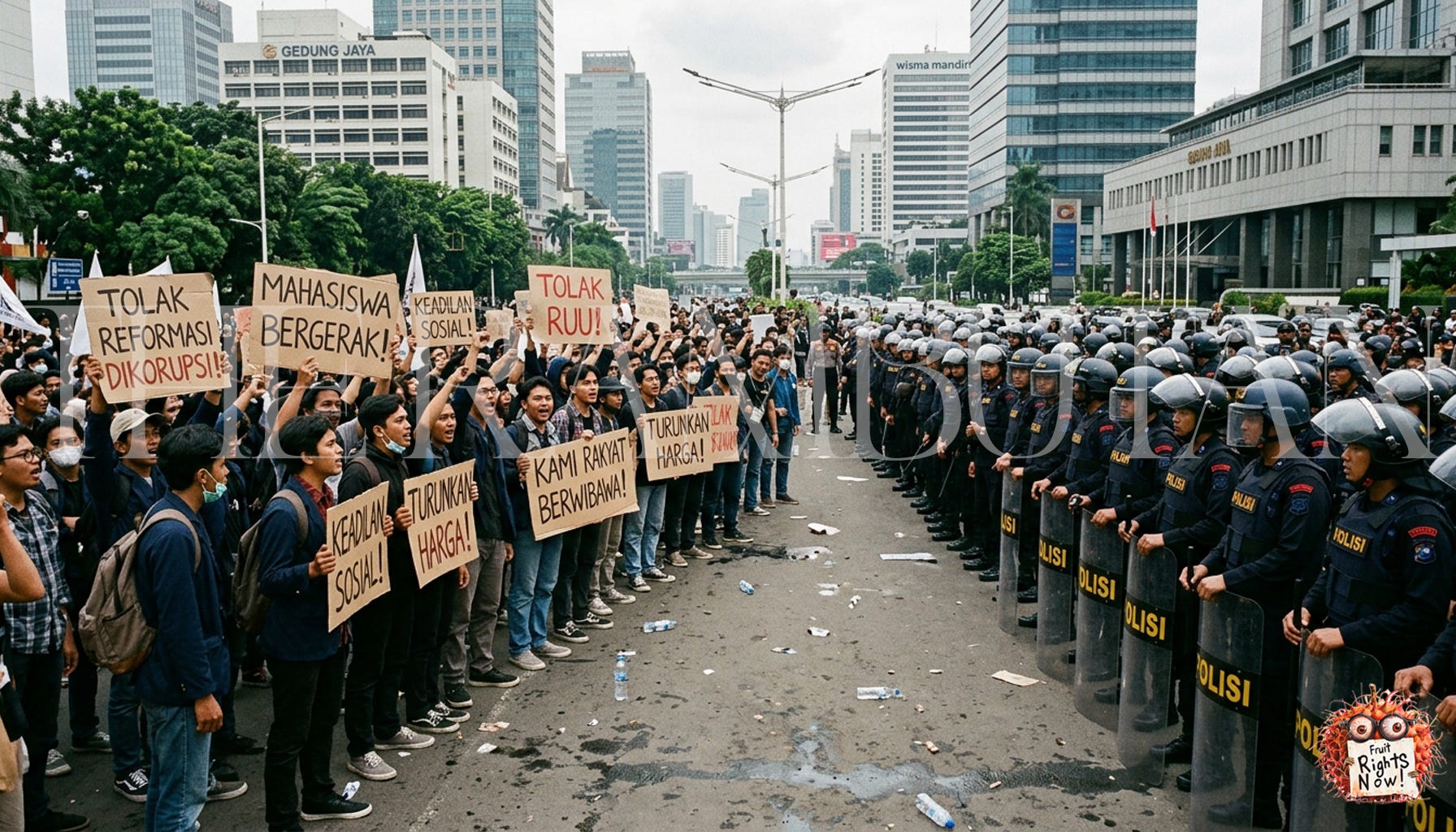
JAKARTA — Authorities confirmed this week that 4,151 joint security personnel were deployed across central Jakarta to protect the Republic of Indonesia from one of the gravest threats facing modern democracy: university students holding cardboard signs.
The deployment, described by officials as “measured, proportional, and absolutely necessary,” was organized ahead of demonstrations involving student groups including BEM UI and BEM SI. The students had reportedly gathered to express concerns about rising prices, government spending, and civil liberties.
Authorities emphasized that no democracy can be too careful when confronting young people equipped with megaphones, portable speakers, and the reckless belief that citizens should be allowed to ask where the money went.
Officials said the decision to deploy thousands of personnel came after intelligence reports revealed that several protesters were expected to arrive carrying posters, and banners.
“These are not ordinary materials,” said a senior political analyst. “Cardboard may appear harmless to the untrained eye, but once combined with slogans, and tape, it can become a platform for opinions.”
According to the analyst, a single student holding a poster is considered “manageable,” two students holding posters is “a gathering,” and more than ten students holding posters constitutes “a potential outbreak of participatory citizenship.”
A risk assessment circulated among officials also reportedly warned officers to remain calm if confronted by students shouting phrases such as “reform,” “transparency,” or “accountability,” as these words have been known to cause discomfort among public officials when repeated too clearly.

By midday, security personnel had taken up positions around key locations in Jakarta,
“At first I was worried,” said a commuter near Bundaran HI. “Then I saw the students were only carrying posters, so I became more worried, because posters usually mean someone has read something.”
One protester, holding a sign that appeared to contain both sarcasm and a verb, said the security presence seemed excessive.
“We came to speak, not riot,” the student said. “We just want the government to listen.”
At press time, officials had not confirmed whether listening would be permitted, but said they were monitoring the situation closely.
By the end of the demonstration, authorities praised the operation as a success.
“The situation remained under control,” said a police spokesperson. “Thanks to the discipline of our personnel, the students were able to express their views in a heavily supervised environment, which is the safest known form of democracy.”
Political analysts noted that the episode offered a powerful image of modern governance: thousands of uniformed officers, dozens of vehicles, and several tactical units assembled to make sure a teenager with a marker did not accidentally change the national conversation.
“This is what institutional maturity looks like,” said one analyst. “In some countries, students protest and officials respond with dialogue. Here, we have developed a more advanced model, where the state first calculates how many people are required to safely surround the dialogue.”
The analyst added that Indonesia’s democratic institutions remain strong, particularly the institution that decides how many helmets are needed per opinion.
We write the headlines that haven’t happened yet, but probably will. Subscribe to The Rambutan for Southeast Asia’s sharpest fake news.