


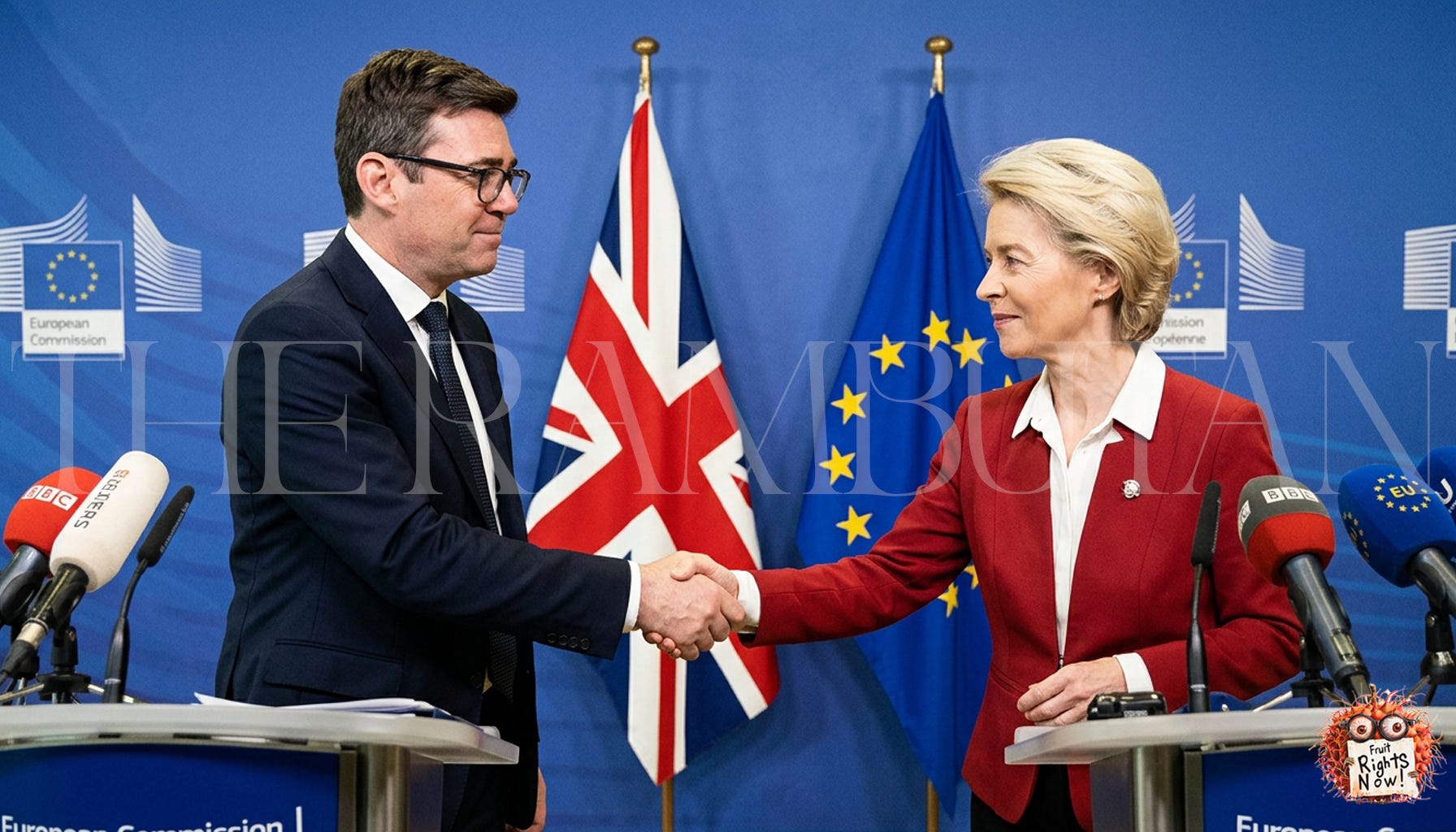
BRUSSELS — British Prime Minister Andy Burnham concluded a summit in Brussels on Friday, officially signing the “Historic UK–EU Strategic Realignment Accord.”
Under the terms of the agreement, the United Kingdom has agreed to hand over an estimated £17 billion annually to the European Commission. In exchange, British citizens will regain the privilege of being patronized by Belgian customs officials to their faces, rather than remotely over automated email forms.
Flanked by European Commission President Ursula von der Leyen and European Council President António Costa, Burnham declared that Britain had finally “ended the dark era of sovereign irrelevance.”
“For a decade, the British people have been forced to languish in the cold isolation of self-governance,” Burnham said. “We were disconnected from the heart of Europe. We were forced to eat British carrots without Brussels-approved certifications. Worst of all, when a French border guard looked at our passports with pure disgust, it had to happen through a digital portal. Today, we put that right. Today, we reclaim our place in the splash zone of continental contempt.”
The negotiations, which dragged on for three weeks at the European Commission’s Berlaymont headquarters, were described by insiders as a lesson in modern British diplomacy, a strategy widely known as “apologizing profusely until the other person takes your wallet.”
Under the terms of the treaty, Britain will immediately harmonize its agricultural standards with EU regulations, meaning British farmers will once again be prohibited from selling crooked parsnips, but permitted to pay a £4,000 annual carbon tariff to the Directorate-General for Agriculture. Furthermore, the UK has agreed to accept full alignment with EU single-market directives on emissions, and fisheries, all while surrendering any right to vote on, debate, or read the laws before they take effect.
“This is what real leadership looks like,” explained Sir Humphrey Appleby-Smith, Whitehall’s chief negotiator for European Subservience. “The previous Conservative governments insisted on silly concepts like ‘national sovereignty’ and ‘keeping our own money.’ Prime Minister Burnham immediately saw the folly in that. Why govern yourself for free when you can pay Germany and France £17 billion a year to do it?”

Perhaps the most universally celebrated pillar of the reset deal is the overhaul of cross-Channel border controls at Dover and Calais.
Under the post-2020 Brexit framework, British travelers had grown frustrated by the impersonal nature of border crossings. Passports were scanned by automated e-gates, depriving British holidaymakers of the traditional experience of being judged by a surly, cigarette-smoking gendarme.
Under the Burnham Accord, that indignity has been rectified. The agreement introduces dedicated “Former Member State” lanes at all major European transport hubs. These lanes will feature heated waiting pens where British travelers can stand while French immigration officers slowly turn each page of their passport, inspect their fingernails, and exhale Gauloises smoke directly into their eyes.
“It is a question of human dignity,” said Jean-Luc Dupont, a senior border control officer stationed at the Eurotunnel terminal in Calais. “Before this accord, I had to look at British people on a security camera and press a red button. It felt cold. Now, under Mr. Burnham’s generous terms, I can smell their damp wool coats. I can look a family from Birmingham in the eyes, confiscate their ham sandwiches, and toss them into an incinerator right in front of their crying children. It brings the humanity back to European integration.”

Back in London, the reaction to the agreement was met with praise across the political and media establishment.
The Guardian published an editorial series praising the prime minister for having the courage to “kneel before our moral betters,” hailing the £17 billion annual bill as “a modest, reasonable subscription fee for the sensation of moral superiority.” On BBC Radio 4’s Today program, commentators expressed relief that Britain would once again be subject to European Court of Justice rulings on sausage packaging, noting that “the national nightmare of feeling slightly independent is finally over.”
When pressed by reporters about how the cash-strapped British Treasury planned to finance the £17 billion price tag, Downing Street released a practical fiscal roadmap.
The payments will be funded through a modest combination of a 40% tax increase on small business owners, an emergency windfall levy on private pensions, and a new “Breathing British Air” surcharge levied on every household with an income over £12,000.
We write the headlines that haven’t happened yet but probably will. Subscribe to The Rambutan for Southeast Asia’s sharpest fake news.
P.s. Have you eaten one??
Am I the only person to believe this PM has sold UK down the drain????…….What was he thinking? Oh, of course, he is a man of Very Little Brain 🧠😭😞